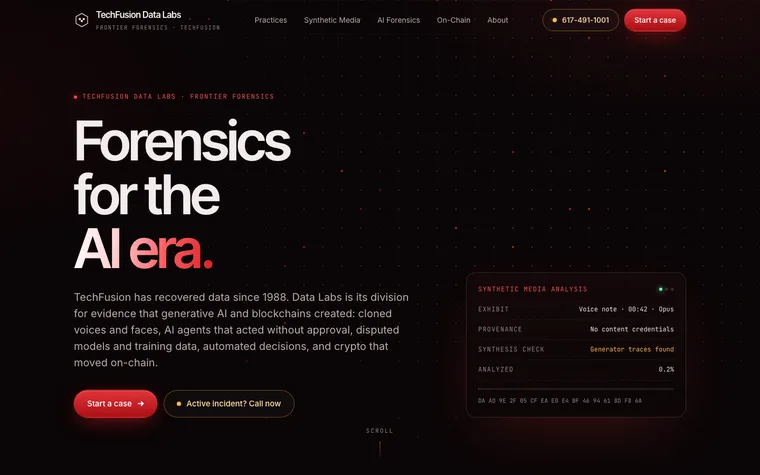
A voice can be cloned in minutes. An AI agent can take actions no person typed. A customer who passed every identity check may not exist.
Those three sentences sit on the homepage of TechFusion Data Labs, and in our view they describe one of the most important shifts in how the world establishes the truth since evidence went digital. Courts, boards and regulators have long relied on a quiet set of assumptions: that a recording of a voice was made by the person who spoke, that a decision traced back to someone who made it, and that a customer who showed their face was a person. Generative AI and public blockchains broke those assumptions, and we believe the institutions that depend on them have only begun to notice.
TechFusion Data Labs exists to put them back together. It examines the evidence that generative AI and public blockchains created: cloned voices and faces, AI agents that acted without approval, disputed models and training data, attacks on identity checks, automated decisions, and crypto that moved on-chain. Caldrion Ventures led its $4M Seed round earlier this year, from Caldrion’s own capital, and we did it with as much conviction as we have brought to anything we have backed.
This letter is the full argument. We want to set out, plainly and at length, why we believe TechFusion Data Labs is building something genuinely new: not a better tool for an old job, but a new kind of institution for a world in which seeing and hearing are no longer believing. We will explain the first principles behind our view, why now, why we expect its advantages to compound, and the world we think becomes possible if it succeeds. We will also be candid about what could go wrong, because a thesis that cannot name its risks is not one we would trust.
A word on our relationship first. TechFusion Data Labs is a portfolio investment: a company founded and led by its own team, as the frontier forensics division of TechFusion, the Belmont, Massachusetts firm that has examined digital evidence since 1988. We led its Seed round from Caldrion’s own capital, which gives us a close view of the work and obliges us to hold our enthusiasm to a higher standard of evidence. Everything that follows is our belief and our vision, argued as carefully as we know how.
The oldest question in a brand-new world
Strip away the technology and forensics answers two questions: what happened, and can it be proved? Those questions are older than computers. A judge asks them. So does a board after a payment goes missing, and a regulator when an algorithm denies someone a loan. The words have barely changed in a generation.
What has changed, completely, is the material those questions must be answered from.
For most of the history of digital forensics, evidence lived on things: a hard drive, a phone, a server, a document. It could be seized, imaged and examined. The work was technical, but the shape of the problem was stable. A file was written by a person using a machine, and the job was to show which person, which machine and when.
Generative AI dissolves that shape. A voice note can now be produced by a model that has never met the person it imitates. A video call can carry a face that belongs to someone who is not on the call. An AI agent can send an email, export a customer list or move money on instructions that no employee ever typed, because those instructions arrived hidden inside an invoice it was asked to summarize. A model can be accused of being a copy of another model, or of having learned from material it should never have seen. And on public blockchains, value can cross wallets, swaps and bridges in minutes, leaving a perfect public record that is nearly impossible for a non-specialist to read.
The questions are as old as justice itself. The evidence is younger than most of the software it runs on.
We believe this gap, between ancient questions and brand-new evidence, is one of the defining opportunities of the decade. The organization that learns to close it, rigorously and credibly, will in our view become part of how societies decide what is true. That is the ambition we see in TechFusion Data Labs, and it is why we led the round.
Where the evidence is new
The lab has organized itself around six practices, each devoted to a kind of evidence that generative AI or blockchains created. We want to describe each in some detail, because the breadth and precision of this map is, to us, one of the strongest signals of the quality of thinking behind the company.
Synthetic media detection. The question is simple to state and hard to answer: was this voice, video, image or document made or altered by a generative AI model? The lab tests speech for the artifacts that text-to-speech and voice-conversion models leave, and for the signs of real-time voice changers. It examines video for the blending boundaries, temporal flicker and audio-to-lip mismatches that face-swap and lip-sync models produce. It tests images for generator signatures and, where the evidence allows, for which family of model produced them. And it reads and verifies C2PA content credentials and AI watermarks, checks whether they have been stripped, and explains “what their presence or absence does and doesn’t prove.” A widely reported case in 2024, in which an engineering firm’s office paid out a very large sum after a video call whose other participants were deepfakes, showed boards everywhere what this practice is for.
AI agent forensics. This is the practice we find most thrilling, because it addresses a problem that barely existed a short while ago. Agents and copilots now act with the permissions they were given, on instructions that can arrive hidden in a web page, an email or a document. The lab’s own phrase for this is unforgettable: “The new insider is software.” When an agent is hijacked or takes an action nobody approved, Data Labs reconstructs “what it read, what it was told and what it did”: prompt injection and guardrail bypass, poisoned retrieval, step-by-step run and tool-call reconstruction, and compromised tool servers and plugins, including MCP servers. It traces which tool definitions a model saw and which calls they produced, and separates what an agent decided from what it was told.
Model and training-data forensics. As models become some of the most valuable assets a company owns, disputes turn to the model itself. Is one model a copy or fine-tune of another? Was a company’s content, code or personal data used to train it? Can it be made to reproduce protected material? The lab compares weights where they are available and behavioral signatures where they are not, uses membership-inference and memorization testing, and tests which AI system produced a given output, always reporting the weight the evidence carries rather than a bare yes or no.
Identity-verification attacks. Remote onboarding trusts a camera and a document scan, and attackers now feed both with generated faces, injected video streams and AI-made IDs. The lab examines camera-injection and virtual-camera attacks, liveness and face-match spoofing, AI-generated ID documents and synthetic identity rings. It starts with a question we think many fraud teams have not yet learned to ask: was this a presentation attack, in which a fake was shown to a real camera, or a camera injection attack, in which the camera was removed from the picture entirely? Each leaves different evidence, and knowing which happened is the beginning of every good answer.
AI decision forensics. Models now help decide who is hired, who gets credit and which claims are paid. When one of those decisions is challenged, the system itself has to be examined, not just the paperwork around it. The lab reconstructs individual decisions, tests systems for bias and disparate impact using selection-rate analysis, counterfactual testing and proxy-variable review, conducts bias audits for automated hiring tools, and verifies whether model cards and risk documentation match how a system actually behaves.
On-chain forensics. Every transfer on a public blockchain is recorded, but, as the lab puts it, “the record is a maze of addresses, swaps and bridges built to be hard to follow.” Data Labs traces stolen or disputed crypto across chains and bridges, clusters addresses by shared funding and spending patterns, identifies the exchange and service deposit addresses where a trail reaches a business that keeps customer records, reconstructs smart-contract and DeFi exploits down to the contract functions called and the flash loans or price manipulations used, and writes tracing reports that exchanges, counsel and courts can act on.
Four readiness programs sit alongside the practices and set things up “before it happens”: a deepfake response retainer with a named examiner on call, an AI agent traceability review, a content credentials program for signing an organization’s own media, and a recurring bias audit program.
Read together, this is not a menu. In our view it is a map of the new evidentiary frontier, drawn by people who understand exactly where the ground has moved.
The detector fallacy
If there is one idea at the heart of our conviction, it is this. The world’s first instinct, faced with synthetic media and misbehaving AI, has been to reach for a detector: a piece of software that takes a file and returns a score. We understand the appeal. It is fast, it is cheap and it feels like an answer.
We believe it is the wrong answer to the question that matters.
A detector gives a score. A court, a board or a regulator needs a finding, and an examiner prepared to explain it.
A score is not evidence. It cannot be cross-examined. It rarely says why it decided. It was trained on the generators that existed when it was built, so it ages from the day it ships. And because it is a single, known target, it can be fooled on purpose by anyone with an incentive to do so, which in a contested matter is precisely the person on the other side.
TechFusion Data Labs was designed around the opposite principle. In its own words: “We use AI tools where they help and never let a single detector’s score stand in for an examiner’s finding.” Independent methods have to agree before the lab reports that a model made something. Provenance data, how a file travelled and the traces in the signal are weighed together. A qualified person reaches and signs every conclusion.
We think this is one of those choices that looks conservative and turns out to be radical. While much of the attention in this space goes to ever more accurate classifiers, the lab has stepped off that treadmill entirely. It is not competing to produce the best score. It is competing to produce the most defensible finding, and in our view that is a different and far more durable business.
The lab’s finding scale captures the difference beautifully. A synthetic media examination ends in one of four statements: consistent with AI generation, partly AI-generated, no AI-generation traces found, or inconclusive. Each has a defined meaning and a typical basis, and the third is always stated with its limits, because new generators may not yet be detectable. No mysterious percentage: a conclusion a judge can read and an opposing expert can test.
First principles: what a forensic answer really is
When we evaluate a company, we try to reason from what its customers fundamentally need rather than from what others happen to sell. Here is our first-principles account of what a forensic answer must be, and why we believe TechFusion Data Labs is built to deliver every part of it.
It must survive an adversary. Most professional work is judged by the client who paid for it. Forensic work is judged by the person most motivated to break it. That single fact changes everything about how a forensic business must operate. Every step must be documented, every method disclosed and every limit admitted in advance, because whatever is hidden will be found and used.
It must rest on original evidence. A copy of a copy is a weaker exhibit than an original, and in the AI era this is more than a technicality. Messaging apps and social platforms re-compress what they forward, and a screenshot or screen recording loses most of what an examiner tests. The lab’s guidance is pointed: “the first copy you have is worth more than a clearer-looking one.”
It must be repeatable. If another qualified examiner cannot follow the method and reach the same place, the finding is an opinion. The lab documents its memorization tests “so the test can be repeated by the other side,” and we think that phrase captures the whole philosophy. It writes for its critics.
It must say how sure it is. Some conclusions are direct: this tool call followed this instruction. Others are probabilistic, such as whether a model saw certain data in training. Every finding at Data Labs states which kind it is, the method behind it and its limits.
It must arrive in time. Evidence that has been deleted cannot be examined, and in the AI era evidence is deleted constantly and automatically.
Five requirements, and in our view the lab has been designed around every one of them. That is the core of our conviction. It is not only that TechFusion Data Labs has clever techniques, although it has many. It is that the company was built from the nature of proof outward.
Preserve first, prove second
The lab describes its method in four steps: preserve fast, acquire originals, analyze independently, report. It sums up the philosophy in four words that we think deserve to become a motto for the whole field: “Preserve first. Prove second.”
The reason preservation comes first is one of the least appreciated facts about AI-era incidents. AI providers purge conversations. Platforms re-encode uploads. Agent logs roll over. The records of a single AI incident are usually split between a company’s own application, its AI provider and the systems an agent called, each with its own retention period. Retention periods vary by provider and plan, and many are short. An organization that suffers an AI incident will either preserve the right records in the first hours or lose them.
The lab’s practical guidance shows it. After an AI agent incident: pause the agent; don’t delete it. Export conversation, audit and tool-call logs now, and ask the AI provider to preserve theirs. Keep the inputs it processed. Record its permissions, connected accounts and system prompt as they stood. After a suspected onboarding attack: hold the flagged applications, export the selfie video and document images as the verification provider received them, and ask the provider to preserve its session records before its retention period ends. After a challenged automated decision: record which model, version and settings were in use, and don’t retrain or reconfigure the system until everything is preserved. After a theft or exploit: write down every transaction hash and address, never share a seed phrase or private key, and move quickly, because “exchanges can only freeze funds that are still there.”
There is a subtle insight here that we think sets the lab apart. Many people assume that to understand what an AI agent did, you can simply run it again. You cannot. The same prompt can give a different answer on the next run, and models, tools and retrieved content change over time. A live re-run can even repeat the harm. A faithful account has to be rebuilt from the records of the run itself, and where the lab re-runs anything, “it is a controlled copy, so the test can’t repeat the harm.”
In the AI era, the most valuable forensic skill may not be analysis. It may be knowing, in the first hour, exactly what is about to disappear.
This is why we believe speed of first response is part of the product, not a service level bolted on afterwards. Every exhibit, log export and model snapshot is hashed on arrival and logged from arrival to return. The first hours of a case are designed, not improvised.
Why now
We believe TechFusion Data Labs is arriving at exactly the moment the world starts to need it, as three forces converge.
AI systems now act, not just answer. When software could only produce text for a person to read, a bad output was an embarrassment. Agents and copilots now send email, call APIs and move data with real permissions. Once software takes actions, its failures become incidents, and incidents become disputes, claims and investigations. In our view this is one of the most important changes in the risk landscape of the decade, and it creates a durable need for people who can reconstruct what an AI system saw, what it was told and what it did.
Synthetic media has become cheap and convincing. In the lab’s words, “A few seconds of someone’s voice is enough to clone it. A single photo is enough to put their face on a video call.” Real-time face swaps can follow active liveness prompts, so turning one’s head on cue is no longer proof of a live person. Every institution that relies on a voice, a face or a document to establish identity or authority is, we believe, now exposed.
Standards and obligations are arriving. Provenance standards such as C2PA content credentials, along with invisible AI watermarks, are being adopted by a growing number of generators and tools. In the United States, some local laws already require independent bias audits of automated hiring tools, and long-standing federal employment guidelines give a common four-fifths screening threshold for disparate impact. We expect scrutiny of automated decisions to grow, not shrink, and every new standard creates work that has to be done correctly and documented so that someone else can check it.
We are deliberately cautious about precise market sizes for a category this young, and our conviction does not rest on one. It rests on a belief we hold strongly: disputes involving AI-generated and AI-mediated evidence will keep multiplying, and the number of firms able to handle them with real forensic discipline will lag far behind. We want to back the firm that closes that gap first and best.
Why incumbents can’t simply follow
A thesis is only as strong as its answer to the obvious question: if this is such a good idea, why won’t someone already in the market just do it? We believe each existing source of supply faces a structural obstacle, not a temporary one; each was built for a different job.
Classic digital forensics firms have the discipline, the chain-of-custody habits and the credibility with counsel. But much of their method, tooling and training was built for drives, phones and documents rather than agents, models and synthetic media. Rebuilding a practice around prompt logs, tool-call traces and generator signatures is not a product update. It is a new specialism, and it takes a deliberate decision to build it.
Detection software vendors move quickly on technology, but their business is selling tools, and a tool’s output is a score. To deliver findings they would need to become services businesses, with examiners who explain their work under challenge and reports written for adversaries. That is a different company, with different economics and a different culture.
Blockchain analytics platforms are strong on the ledger, but their output is data that someone still has to turn into a report an exchange’s compliance team, counsel or a court can act on. And their expertise is centered on the chain; it does not usually extend to the deepfake call that may have started the theft.
We think the opening sits precisely at the intersection: an examiner-led lab that uses new methods where they help and keeps the old discipline everywhere. That is a services business with technology inside it, not a software business with a services team attached. The incumbents who could build it would have to unlearn part of what made them successful. A new entrant could build it, but would have to earn trust from a standing start.
TechFusion Data Labs is, in our view, unusually well positioned between those two constraints. It inherits the trust and the discipline. It was built fresh for the new evidence. We believe that combination is extraordinarily hard to copy.
Why this compounds
The businesses we admire most get better, and harder to compete with, every time they do their work. We believe TechFusion Data Labs has at least five compounding loops built into its design.
Credibility compounds. In forensics, every finding that is tested by an opposing expert and holds makes the next one more persuasive. A name that counsel recognize is the most valuable asset in the field, and it can only be built one case at a time. Data Labs starts with TechFusion’s record of examining digital evidence since 1988, and we expect it to add to that record with every case.
In forensics, credibility compounds slowly and can be lost in a single overstated report. We want to back a company that is built to understate.
Readiness compounds. The four readiness programs put the lab inside an organization before anything goes wrong. A deepfake response retainer means a named examiner, a verification protocol for payment and executive requests, and a playbook for the day a synthetic version of the client’s leadership appears. An AI agent traceability review means the logs that matter are already being kept. A content credentials program means the client’s genuine media can be told apart from fakes of it. A bias audit program means the documentation regulators ask for exists before anyone asks. Each makes the lab faster and better on the day of an incident, and each can turn a one-off emergency into a lasting relationship. We think this is one of the most elegant ideas in the company.
Method compounds. Every case teaches the lab something about how a new generator, a new agent platform, a new bridge or a new identity attack leaves its traces. Because every method is documented so that someone else can repeat it, that knowledge belongs to the lab rather than to any single examiner.
Cross-practice insight compounds. Real incidents do not respect category lines. A deepfake call can be the front end of an identity fraud whose proceeds leave on-chain. A synthetic identity ring can be linked through shared generation traces, reused assets and session patterns that only someone fluent in both media forensics and fraud would notice. A lab that sees across all six practices, we believe, sees patterns that specialists in one cannot.
Restraint compounds. This may surprise people, but we believe the lab’s willingness to say what it cannot do is one of its deepest advantages. Some recordings support only “inconclusive,” and the lab says so. Some crypto trails end at privacy coins, some mixers or inside an exchange’s own books, and the lab says that early. In a field where people who have lost crypto are often approached by “recovery” offers that ask for seed phrases, the lab states flatly that it never asks for seed phrases, private keys, passwords or wallet access, because tracing works from the public ledger alone. Every honest “we can’t prove that” makes every “we can” more valuable.
One lab, one discipline, six frontiers
Six practices can look, at first glance, like a lack of focus. We read it as the opposite, and we think this is one of the places where the team’s thinking is most original.
What unites the practices is not a technology. It is a rule: the lab takes only evidence that generative AI or blockchains created. Within that boundary, the method is the same everywhere. Preserve first. Acquire originals. Use several independent methods. State confidence and limits. Let a person sign. A client facing a tangled incident wants one examiner who can follow it end to end, not three vendors with three report formats and three sets of assumptions.
The tracing reports show how the discipline travels. A crypto trace at Data Labs separates what the ledger proves from what is inferred: a direct transfer path is cited by transaction hash; a bridge or swap match rests on records, amounts and timing on both sides; an address cluster is stated as an inference with its confidence; and a trail that ends is reported as ending. It is the same intellectual honesty as the synthetic media finding scale, applied to a completely different kind of evidence. That consistency is, in our view, the signature of a company with a real philosophy rather than a collection of services.
The boundary works in the other direction too. Nothing at Data Labs repeats a TechFusion service. Data recovery, classic computer and phone forensics, audio and video forensics, incident response, e-discovery and the rest stay at techfusion.com, and the lab’s website sends people there. We find this discipline unusually mature for a young company. It keeps the lab pointed at the frontier and keeps the two businesses from competing for the same client.
Built from the inside
We have come to know the team’s thinking in detail, and it is the quality of that thinking, as much as the opportunity, that gives us conviction.
The trust is old even when the evidence is new. Data Labs is a division of TechFusion: same company, same headquarters in Belmont, Massachusetts, same chain-of-custody standards. The hardest thing to build in this field is not a classifier. It is a long record of careful practice and a name that counsel recognize. Starting from that foundation, rather than from a blank page, is a large part of why we believe the lab can earn trust faster than a new entrant could.
Humans decide. AI tools assist the examiners; a qualified person reaches and signs every conclusion. For a business whose product is accountability, we believe this is the only defensible design, and it is also a statement about the future we want: one in which AI makes skilled people more capable rather than standing in for their judgment.
Confidential by default. NDAs on request, need-to-know access, encrypted delivery and secure disposal at close. Case details sent through the website are deleted from its database two years after they arrive, and the lab does not sell personal information.
Launched with discipline. The team built the lab’s operating foundation: a website launched in October 2026 with six practices and four readiness programs; a confidential case intake by form or emergency line, with “a confidential first consultation, a clear scope and quote, and no work until you say go”; and measurement that shows which practices and pages bring in cases. Clients meet the lab by appointment in Boston, Cambridge, New York, Stamford and Washington, DC.
Even the website teaches. Its “Inside a case” section walks through four scenarios, clearly labeled as illustrations rather than real cases: a cloned voice note asking for an urgent wire, a helpful agent that followed hidden orders in a supplier’s PDF, a perfect applicant who passed onboarding through a virtual camera, and stolen tokens that hopped a bridge to a second chain. Each ends in a line we think captures the lab’s worldview. Of the voice clone: “No single detector decides.” Of the agent: “The instructions arrived inside a document the agent was asked to read.” Of the identity attack: “The liveness check never saw a real face, only a stream it was told was one.” Of the trace: “The ledger is public, so speed matters more than access.”
These details are not glamorous, and that is why they matter: the company is being run the way forensic work has to be run.
The risks we hold
Enthusiasm is only worth something if it has looked hard at what could go wrong. These are the risks we spend the most time on, and how we think about each.
Examiner talent. People who combine forensic discipline with current AI and on-chain expertise are scarce. We treated building the examiner bench as the core purpose of the round, and we favor documented, repeatable methods that let good examiners work consistently rather than depending on a few individuals.
An adversarial arms race. Generators improve, and detection methods go out of date. We do not underwrite the lab as a detection company. Its value rests on preservation, provenance data, several independent methods and honest reporting of limits, all of which hold up better than any single detector as the technology moves.
Scrutiny in court. New techniques draw hard questions. The lab’s reports aim to answer them up front: what was done, why it is reliable and what it cannot tell you. We will watch closely how its findings fare when they are tested.
The cost of a wrong finding. One overstated conclusion can damage a reputation built over years. The safeguards are structural: independent methods must agree, a person signs every finding, and “inconclusive” is always an acceptable answer.
Uneven demand and category timing. Incident work is episodic, and some practices, such as AI agent forensics and model provenance, address problems that are growing but not yet routine. The readiness programs are how we expect the lab to build steadier relationships, and six practices give it more than one path while the newer ones mature. We may be early in parts of the lab. We would rather be early to the right future than on time to the wrong one.
The relationship with TechFusion. The lab’s credibility draws on TechFusion’s standards and record. That is a strength and a dependency, and the clear boundary between the two is how we keep it clean.
Each of these is a risk of execution in a field we believe is growing. None is a bet that a need will appear from nowhere. Those are the kinds of risks we are built to hold.
What the round was for
The Seed round was meant to carry the lab from a launched practice to an established one. In qualitative terms, it was for:
- Examiners and methods. Deepening the bench across the six practices, and keeping methods current as generators, agent platforms and chains change, with every method documented so that someone else can repeat it.
- Readiness programs. Turning the deepfake response retainer, the agent traceability review, the content credentials program and the bias audit program into repeatable engagements with a clear scope.
- Preservation and custody. Procedures and tools that make the first hours of a case faster and more complete, from preservation requests to AI providers and platforms to hashed, logged acquisition of originals.
- Case intake and measurement. A case channel that is legally reviewed, protected against spam and measurable from first inquiry to engagement.
Caldrion Ventures led the round from Caldrion’s own capital. Any co-investors invest directly in the company, never into a Caldrion vehicle. Decisions on our side are made by a small internal investment committee that meets weekly; we need no outside approvals to act. Alongside the capital, the lab keeps the studio’s product, engineering, design and AI teams, who built its foundation and will keep building with it. Because our capital is not tied to a fixed timetable, we can let the lab earn its reputation at the pace forensic work demands.
The world we believe is coming
Picture the world we think TechFusion Data Labs can help build.
A finance team receives a voice note from its chief executive asking for an urgent wire. Instead of panic or blind obedience, there is a protocol: the request is verified through a channel the team already trusts, the original is preserved, and a named examiner is on call. Within hours, the organization knows what can be proved.
A company runs AI agents across its operations, confident not because nothing will go wrong, but because every agent records its prompts, retrieved content and tool calls well enough that, if something does go wrong, it can be reconstructed precisely. Accountability for software becomes as normal as accountability for people.
An organization signs its genuine photos, video and statements with content credentials, so that when a fake of its leadership appears, the real thing can be told apart from it. Authenticity becomes something an institution can assert and demonstrate, not just hope for.
A person turned down for a job or a loan by an automated system can have that decision reconstructed and tested, and an employer can show, with documentation an auditor can check, how its tools treat different groups. Automated decisions become explainable rather than final.
A victim of crypto theft, instead of falling prey to a fake “recovery” service, receives a trace written so that an exchange, law enforcement and a court can act on it, while the funds may still be there to freeze.
We believe the next decade will need a new kind of institution: one that can tell the world what a machine did, and prove it.
That is the world we are backing. Not a world without deepfakes, hijacked agents or synthetic identities, which we think no technology can promise, but a world in which they no longer have the last word. A world in which the truth has a professional defender, equipped for the evidence of the age. If TechFusion Data Labs succeeds, we believe it will help restore something societies cannot function without: the ability to establish, credibly and in public, what actually happened.
How we will know
We will judge progress by evidence, the same standard the lab applies for its clients. If we are right, in three to five years TechFusion Data Labs will be among the first calls counsel, insurers and fraud teams make when evidence involves AI or a blockchain; its findings will have been tested by opposing experts and held; a meaningful share of its work will come through readiness relationships that begin before an incident; each practice will carry real work; and it will have a bench of examiners trained in its methods, so its quality does not depend on any one person.
The measures we will watch most closely:
- Speed to preservation. How often preservation begins within the first hours of a case.
- Quality of findings. How findings fare under challenge, and how consistently reports state their confidence and limits.
- Readiness relationships. How many organizations take up a readiness program, and how many renew.
- Repeat and referred work. How much work returns from the same counsel, insurers and organizations, or arrives through their referrals.
- Breadth. How evenly cases spread across the six practices.
- Discipline at intake. Time from first contact to a clear scope and quote, and how often the lab tells a client early that the evidence cannot support what they hoped.
That last measure is deliberate. A lab that is willing to say “inconclusive” is a lab we can trust with the hardest cases.
We do not promise outcomes. Our conviction is a belief about where the world is going and about the people building toward it. We believe the questions courts, boards and regulators ask have not changed, that the evidence has changed beyond recognition, and that the firm that answers best will be the one that brings an old discipline to new problems with energy, imagination and honesty. We believe that firm is TechFusion Data Labs. We are backing it with our own capital and our own people, and we are proud to.
— Caldrion Ventures
This letter reflects Caldrion Ventures’ views as of November 2026. It is not an offer of securities or investment advice.