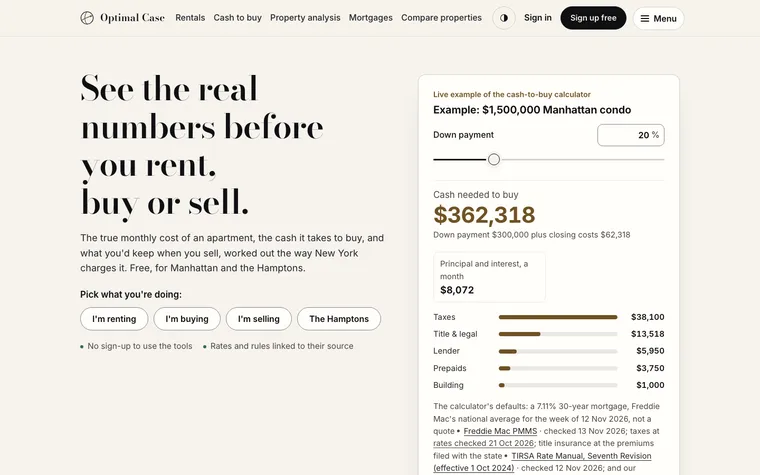
Every so often a product arrives that makes you wonder how the world ever worked without it. Not because it is flashy, and not because it shouts, but because once you have seen it, the old way looks faintly absurd. We believe Optimal Case is one of those products.
Caldrion Ventures led Optimal Case’s $2M Seed round in 2026. Optimal Case was originated and built by our own studio, and we committed a Seed round of Caldrion’s own capital to it because we believe, with as much conviction as we have brought to anything, that it is the beginning of a new and lasting category: the honest number. A place where a person renting, buying or selling a home in New York can see what that decision really costs, worked out the way New York actually charges it, with every rate and rule linked to its source and dated the day it was checked.
That may sound modest. We think it is anything but. Housing is the largest, most emotional, most consequential financial decision most households make, and it is made, again and again across a lifetime, with numbers that are incomplete, flattering or simply wrong. A product that fixes that does not merely help with a transaction. In our view, it changes the balance of power between people and the most important market in their lives.
This letter is our case, made in full. It is unapologetically enthusiastic, because we are. It is also, we hope, rigorous, because enthusiasm without reasoning is not worth publishing. Backing a company we built ourselves demands more explanation, not less, and the same small investment committee that decides every Caldrion Ventures investment considered this one on its merits, with the same questions we would ask of anyone. What follows is why the answer was yes, and why we are more convinced today than the day we said it.
The most expensive guess most people ever make
Picture the moment. A renter stands in a freshly painted one-bedroom, the broker checking a phone, two other couples waiting in the hallway. The listing says one figure. The lease will say another. Somewhere between them sit the free months that make up the “net effective” rent, the broker fee, the amenity charge, the deposit, the utilities and the cost of simply moving in. The renter has perhaps ten minutes to decide whether this apartment is better than the three they saw last weekend. They will almost certainly decide on the headline.
Now picture a buyer. They have saved for years. They have a listing price and a lender’s estimate, and they believe they know what it will take to close. Then the stack arrives: the mansion tax, the mortgage recording tax, the city and state transfer taxes, title insurance at filed rates and, out east, the Peconic Bay tax, each varying by borough, by town, by property type and by price. On a Manhattan condo, Optimal Case’s own worked example shows closing costs running well into the tens of thousands of dollars on top of the down payment. The money is real. The surprise is optional.
Now picture an owner deciding whether to sell or to rent the home out, with only a hazy sense of what transfer taxes, commission, a co-op’s flip tax and the mortgage payoff will leave in their hands.
In New York, the number you are shown is rarely the number you pay. We believe that gap is one of the most expensive, and most fixable, problems in American life.
Every one of these people is making a very large guess. Not because the information does not exist. It does, scattered across statutes, agency pages, tax bulletins and rate manuals. They are guessing because no one has taken New York’s own rules, applied them to their own numbers and shown the working. Until now.
A category built backwards
Here is the observation at the heart of our thesis: the information people rely on for housing decisions has been shaped, overwhelmingly, by who pays to produce it.
Listings are paid for by the people letting and selling homes. Mortgage calculators sit in front of mortgages. Guides are often written by those paid when a transaction closes. None of this is sinister, and a great deal of it is genuinely useful. But it means the economic engine of the category has always pulled toward the transaction, not toward the full and sometimes inconvenient truth about its cost. Showing a renter that the apartment really costs more than its headline, or walking a buyer through every line of a closing statement with who pays and why, is rarely what the business model rewards.
The other great source of housing information is the primary material: the law itself, the rate schedules, the rent regulation records. It is authoritative and almost entirely unusable by a normal person on a Tuesday evening. It will tell you the mortgage recording tax rate. It will not tell you what you owe on this apartment, at this price, with this loan.
Between the interested party and the inscrutable statute lies an enormous gap. We believe it has persisted for a simple structural reason: closing it requires slow, exacting, market-by-market work that does not scale neatly, and that pays off only when people learn to trust it. Broad platforms are built to scale; they are not built to sweat the Peconic Bay tax by East End town.
The category was built backwards: around the transaction first, and the person second. Optimal Case turns it the right way round.
That gap is exactly the kind of opportunity our specialist information theme exists to find: an engaged audience making recurring, high-stakes decisions; information that is costly to assemble and costlier to keep current; and a premium on clear sourcing and freshness. When we saw the shape of it, we did not want to wait for someone else to fill it. We built the company that would.
First principles: what a person actually needs
Strip a housing decision down to its essentials and a person needs exactly three things. We designed our conviction around them, and Optimal Case was built around them.
First, the true cost. Not a national average with a disclaimer. The right tax, at the right rate, for the right property, in the right place, worked out the way the city and state actually charge it.
Second, the reason behind every figure. A number you cannot check is a number you cannot rely on. For a decision this large, people deserve to see where a rate came from and when someone last confirmed it, and to know which figures are official, which are commonly cited and which are estimates.
Third, a fair comparison. Nobody decides in a vacuum. The renter is weighing four apartments; the buyer is weighing a co-op against a condo, or two Loan Estimates against each other; the owner is weighing a sale against a few years as a landlord. The value is in the comparison, made on equal terms.
That is the whole product brief, and it is captured in a single line on the Optimal Case homepage: “See the real numbers before you rent, buy or sell.” We have read a great many mission statements. Few are this short, this concrete or this hard to live up to. That is precisely why we love it. A promise that demanding is a moat for anyone willing to keep it.
Why now
Great companies are not just good ideas. They are good ideas whose moment has arrived. We believe three forces make this the moment for Optimal Case.
The rules are changing faster, and mattering more. New York has reshaped how renters are charged and protected. The FARE Act limits the broker fees a tenant can be asked to pay. The Good Cause Eviction law changed the protections many tenants have. Rent stabilization, the city’s Rent Freeze Program and the state’s rules on deposits and application fees all bear on what a renter can be charged. Every change is a new reason for people to check, and a new test of whether a source is current. When the rules move, static information decays. A product that is visibly, verifiably kept up to date becomes more valuable with every amendment.
People expect to check for themselves. We believe a growing share of renters and buyers now arrive at a viewing, an offer or a closing having done their own homework, and they are less willing to take a headline on faith. They do not want to be told. They want to be shown. Optimal Case is built for exactly that person.
Building something this deep has become radically faster. Our studio built Optimal Case’s website, its calculators and its native apps for iPhone, iPad and Android in a matter of weeks. Modern tooling, including the applied AI our studio uses throughout its own engineering work, lets a small, disciplined team ship a broad and carefully tested product at a speed that would have been unthinkable not long ago. This, in our view, rewrites the economics of specialist information. The depth that once demanded a large team and years of effort can now be reached by a focused team in a season, provided the discipline about sources is never compromised. Optimal Case is proof of that thesis in production.
What the studio built
Optimal Case launched at optimalcase.com in October 2026, for renting, buying and selling a home in Manhattan and the Hamptons. It opened with 28 free tools and 20 guides, organized around the only question that matters to a visitor: what are you trying to do?
For renters, the centerpiece is the rental tracker, and it is a joy. Add the apartments you are considering and it works out each one’s true monthly cost, net effective rent turned back into the rent on the lease, plus fees, extras and utilities, alongside the cash to move in, the total over the lease and the income landlords will ask for. It ranks them by your own priorities, lets you compare them side by side and checks each one’s fees against New York’s rules, with sources. Around it sits a remarkable set of tools: the rent you qualify for under the 40x rule, net effective rent, rent or buy, renew or move, Housing Connect income bands against the city’s published chart, a check on whether Good Cause Eviction likely covers your apartment, a Rent Freeze Program check, a guide to heat, hot water and repairs with a repair-request letter to print, a move-in inspection checklist, a stabilized rent history check and a “check a building” tool that links straight to a building’s official records.
For buyers, there is cash to buy and closing costs for New York City and the Hamptons, “itemised with who pays and its source,” with dedicated pages on the mansion tax, the mortgage recording tax, transfer taxes, the Peconic Bay tax and title insurance. Around it: what you can afford, a co-op board worksheet, mortgage comparisons, a side-by-side comparison of Loan Estimates, a refinance check and a check of the Closing Disclosure. That last one deserves a moment. A tool that helps an ordinary buyer check the final paperwork before they sign is, in our view, quietly revolutionary. It is the kind of help that used to require knowing the right person.
For sellers, there is net proceeds, sell or rent it out, and a capital gains estimate. And for anyone who wants to test a property’s numbers, there is property analysis and a way to compare properties.
Underneath all of it sit the guides, a glossary and our favorite page on the internet this year: “How we calculate.” For every tool it sets out the sum, every number the tool starts from, where that number comes from and what the tool leaves out on purpose. Every default is marked as one of five things: an official source, a commonly cited figure, our estimate, an example input or a neutral starting point. And the page notes that its figures “are read from the same code the calculators run,” so it cannot drift out of date when a default changes. We know of very few consumer products, in any category, that are this candid about their own machinery.
A methods page that is generated from the code itself is not documentation. It is a promise, enforced by engineering.
And then there are the apps. Optimal Case for iPhone, iPad and Android is built and coming soon to the App Store and Google Play, free, with no account, no ads and no in-app purchases. The apps bring the rental tracker and the calculators onto the phone, and they add something the website cannot: help in the room itself. A guided viewing or a move-in or move-out inspection, room by room, with rooms built from the bedrooms and bathrooms; every item rated Good, Fair or Poor with a note; photos tagged to the room and item, stamped with the time and, if you allow it, the place; voice notes turned into text on the device; defects recorded by severity and cost; readings for noise, light and signal; room size by LiDAR on supported iPhones and iPads; and a condition report to share or print. On iPhone there are widgets, a Live Activity for a viewing in progress, Siri and Shortcuts, and a Face ID lock. Both apps work in English and Spanish.
Think about what that means for a tenant at move-out, facing a dispute about a deposit, holding a dated, room-by-room record they made themselves on move-in day. That is not a calculator. That is leverage, placed in the hands of the person who has historically had the least of it.
Craft is the thesis
At Seed, the most important question about any company is whether the people building it make good decisions repeatedly, under pressure, when no one is checking. Optimal Case is built by our studio’s product, engineering, design and AI teams, and the public record of how they built it is the best evidence we can offer. It is, frankly, the evidence that made us most excited.
They chose the hard version, every time. It would have been easy to ship calculators with national defaults and a general disclaimer. Instead the team applied New York’s own rules, down to the Peconic Bay tax by East End town and title insurance at the filed rates, and linked each to its source with the date it was checked. That choice costs time on day one. We believe it pays for itself every day after.
They are rigorously honest in small things. Every feature on the site says, before anyone clicks, whether it is available now, needs a free account, is a sample or is coming later. Features not yet built, such as analyzing a listing from its link or shared deal rooms, are clearly marked as coming later rather than implied. Sample apartments are labeled as samples. A team that will not overstate a feature is a team that will not quietly overstate a number. In a business whose entire value is trust, we regard that as the single best leading indicator there is.
They treat consistency as law. Optimal Case runs one calculation model in two places: the same code renders the first page on the server and recalculates in the browser, and the team’s own rule is that “the first paint and every slider move must agree to the cent.” Every model page works without JavaScript; the page address holds the whole scenario, so any result can be shared, bookmarked or printed. The native apps are ports of the website’s calculators, tested against fixtures generated from the website’s own code, so the numbers on a phone in a hallway match the numbers on a laptop at home. A product whose figures disagree between screens has lost the only thing it sells. This team will not let that happen, and they have built the machinery to make sure of it.
They respect the person on the other side. Most people never need to share anything with Optimal Case. Every tool works without an account. A free account only saves a person’s own apartments, members can download everything they have saved and can delete their account immediately. The apps go further still: they need no account and use no analytics, ads or tracking. As the app pages put it, “Something leaves your device only when you tap Share.” Estimates and sample figures are “for information only, not financial, legal or tax advice.”
In a category where trust is the asset, restraint is not a cost. It is the competitive advantage.
We have seen many teams talk about trust. We have rarely seen one encode it this thoroughly into architecture, copy and product decisions all at once. That is what we backed.
Why the obvious competitors cannot simply follow
The natural question for any new category is: why won’t someone larger just do this? We have thought hard about it, and we believe the answer is structural, not a matter of effort or talent.
Incentives are hard to unwind. A business that earns when a transaction happens can certainly build excellent tools, and many do. But being relentlessly candid about every cost of a transaction, including the ones that make a listing or a loan look less attractive, sits in tension with that model. We do not think that tension makes anyone’s information wrong. We think it makes the honest-number position genuinely difficult for a transaction-driven business to occupy wholeheartedly. Optimal Case was designed from its first line to occupy it, with nothing to sell the person on the other side of the screen.
Depth does not scale the way platforms like to scale. The economics of a national platform reward breadth: the same template, everywhere. The economics of the honest number reward depth: the right tax for this town, this property type, this price band. A platform can copy a calculator page in an afternoon. What it cannot copy in an afternoon is the discipline of maintaining a large, interlinked body of sourced and dated figures, and the culture that refuses to publish one it cannot stand behind.
Trust cannot be bought quickly. A brand built on neutrality earns its reputation one correct number at a time. It cannot be acquired with a marketing budget, and it cannot be bolted onto a product whose users already understand where its incentives lie.
Speed is now on the side of the focused. The same shift in tooling that let our studio build Optimal Case in weeks means a small, disciplined team can now match the breadth of a much larger one in a single market, while keeping a standard of care that larger organizations find hard to sustain. In our view, that inverts an old assumption about who wins in specialist information.
The compounding engine
Here is the part of the thesis that excites us most, and that we believe others are most likely to miss: Optimal Case gets better, and harder to catch, with every single thing it adds.
Every tool draws on the same shared body of rates and rules. When a rate changes, it changes once and flows through every calculator, every guide and, via the shared fixtures, every app. Each new tool makes the existing ones more useful, because it links to them. Each new guide gives people a reason to reach a tool, and each tool gives people a reason to read the guide behind it. The methods page grows with the product, automatically, because it is read from the same code.
Most products accumulate features. Optimal Case accumulates verified knowledge. And verified knowledge, maintained with discipline, behaves like an asset: it appreciates as it is extended and cross-checked, and it becomes progressively harder for anyone starting from zero to reproduce.
There is a second compounding loop, and it runs through people rather than code. Every scenario lives in a shareable page address. A renter can send her partner the exact comparison she is looking at. A buyer can send his attorney the itemized closing costs. An owner can send the sell-or-rent analysis to a sibling who co-owns the home. Every one of those shares carries the product, and its sourcing, to someone new, at the precise moment they care.
We did not bet on a calculator. We bet on a body of knowledge that compounds, and on a habit of checking that spreads one shared link at a time.
A housing life, not a housing transaction
Most housing products are built around a single moment: the search, the listing, the loan. We believe that is a profound misreading of how people actually live.
A person who uses Optimal Case to compare their first apartment will face a renewal. Then perhaps a move, then perhaps a purchase, a refinance, a co-op board package, eventually a sale or a decision to rent the home out. Each of those is a large decision governed by detailed local rules, and Optimal Case already has a tool for nearly every one of them. The product is not a moment. It is a map of a person’s entire housing life in a market.
That changes everything about the relationship. A product trusted at the first decision has a natural, earned claim on every one that follows. Renew or move? There is a tool. Does Good Cause cover you? There is a tool. Should you refinance? Is it time to sell? There are tools for those too. The person who arrived as a nervous first-time renter can, in our view, be the same person who years later checks their seller net proceeds on the same site, with the same standard of sourcing, and the same feeling of finally being on solid ground.
We backed a company built around a person, not a transaction. We believe that is a fundamentally stronger foundation, and a fundamentally kinder one.
Where applied AI fits, and where it must not
We are a studio that builds with AI every day, and Optimal Case sits in our applied AI theme for good reason. But we want to be precise about how we think AI belongs in a product like this, because we believe getting it right is a defining advantage.
Some of the features Optimal Case marks as coming later are natural homes for applied AI: analyzing a listing from its link, its address or a photo of it. Imagine pasting a listing and, in seconds, seeing its net effective rent turned into the rent on the lease, its fees checked against New York’s rules and its true monthly cost placed alongside the apartments already on your list. Imagine photographing a listing sheet at an open house and getting the full cash to buy. That is the kind of magic that, in our view, can make careful financial thinking effortless for everyone, not just for the people who already know what to ask.
But here is the principle that makes us confident: AI can read the listing; it must never invent the number. Every figure that results must still be calculated by the same tested model and checked against its source, and labeled for what it is. Already the apps turn voice notes into text on the device, privately. That is the pattern we expect: AI as a tireless, private assistant that removes friction, wrapped around a core of sourced, deterministic, auditable arithmetic.
We believe many products will reach for AI that sounds confident. We expect Optimal Case to win by pairing AI with something rarer: numbers you can check.
The world we believe Optimal Case can help build
Allow us, for a moment, to describe the future we are investing in.
Imagine a New York where no renter signs a lease without knowing its true monthly cost, because checking takes thirty seconds and costs nothing. Where a tenant at move-out holds a dated, photographed, room-by-room record of the apartment they moved into, and a deposit dispute becomes a matter of evidence rather than who is more persuasive. Where every buyer reads their Closing Disclosure with a tool beside them, and the mansion tax is never again a surprise. Where an older tenant discovers, in a few questions, that they may qualify for the Rent Freeze Program. Where an owner deciding whether to sell sees, clearly, what each path leaves them with.
Imagine a market where the honest number is simply expected. Where professionals who serve these households, the good brokers, attorneys and lenders who already work hard to be straight with their clients, can point to a neutral reference and say: check it yourself. In our view, a market where everyone can see the real numbers is not only fairer to renters and buyers. It is better for every participant who has nothing to hide.
And imagine what that does to the texture of people’s lives. Fewer bad leases signed in a hurry. Fewer savings drained by costs nobody mentioned. Fewer arguments, fewer regrets, more confidence. Housing touches almost everything: where children go to school, how long a commute takes, whether a family can save. We believe that improving the quality of housing decisions, even modestly, at scale, is one of the most meaningful things a technology company can do.
The future we are backing is simple to describe: a world where nobody makes the biggest decision of their life on a number they cannot check.
That is the ambition. Manhattan and the Hamptons are where it starts, deliberately, because depth in one market is how trust is earned. Whether and where Optimal Case goes next is a decision we want the evidence, and the standard of sourcing, to make. But we would not have built it, and we would not have backed it, if we did not believe the idea is bigger than any one map.
What the round was for
The Seed round was for turning an exceptional launch into an enduring product. In qualitative terms, it was committed to four things, each grounded in the company’s published plans.
Taking the apps to the stores and to the people who need them. The iPhone, iPad and Android apps are built and on their way to the App Store and Google Play. The round provided for their release and for the work that follows: watching how people use guided viewings and inspections, and making them better.
Connecting the website and the apps. Today the apps keep everything on the device, by design, and the website’s free account saves a person’s apartments. Syncing the two is planned. Doing it while keeping every privacy promise people have been given is careful work, and a priority.
Building what the site marks as coming later. Optimal Case lists what it intends to build next: analyzing a listing from its link, address or photo; shared deal rooms for deciding with a partner; rate alerts; and, in the apps, Wallet passes for open houses, a nearby mode and Apple Watch. These are the features that take Optimal Case from a superb set of tools to the place a household runs a housing decision from start to finish, together.
Keeping every number right. A meaningful part of the round was set aside for the unglamorous work that underpins everything else: re-checking rates and rules as they change, extending the guides and keeping the methods page complete. In our view, this is not overhead. It is the product.
What we are watching, and what could go wrong
Conviction is only credible when it is honest about risk, and we hold ourselves to the same standard of candor we admire in the product.
Monetization is unproven. As the site says plainly, “There’s no paid plan yet.” We did not lead this round on the assumption that any particular model will succeed. We believe specialist information businesses can earn in several ways, through membership, tools and partnerships, and the site already invites property professionals to apply to a directory. Whatever Optimal Case does, it must never compromise the neutrality that makes it valuable. We will test this deliberately, with clear rules about what the product will not do.
Accuracy is a responsibility as well as an advantage. A product that promises the real numbers is exposed when a number is wrong. Rules change; rates are revised; estimates drift. That is why sources are linked and dated, estimates are labeled, the methods page is generated from the code and upkeep is a resourced, scheduled responsibility. We would rather Optimal Case grow more slowly than publish a figure it cannot stand behind.
The market is deliberately focused. Depth in Manhattan and the Hamptons is how trust is earned. The risk is that the audience proves narrower than we believe, or that expansion later dilutes the discipline. We will judge any expansion by whether the same standard can be met.
Larger players could move. We take that seriously, for the structural reasons described above, and we believe the maintained body of sourced figures, and the culture behind it, are not quickly reproduced.
This is our own company. Because the studio built Optimal Case, we guard against conviction turning into affection. We hold the company to explicit milestones and review them with the same committee and rigor we bring to every investment, and we report progress on its profile.
The measures we will watch are the ones that test the thesis directly: accuracy and freshness (how current the checked dates are, how quickly a changed rule is reflected, how rarely a figure needs correcting); return use across decisions (whether people come back, and move from renting to renewing, from comparing to buying); depth of use (saved apartments, shared scenarios, completed viewings and inspections); trust signals (what people tell us, how the apps are rated, whether professionals ask to be associated with the product on its terms); and a tested way to earn that never compromises the promise.
Why we are all in
We have tried, in this letter, to show our working, because that is what Optimal Case does, and because a thesis that cannot be checked is worth no more than a number that cannot be checked.
Here is the conclusion. We believe Optimal Case addresses one of the most consequential and least-served problems in everyday life. We believe it was built with a standard of craft and honesty that is genuinely rare. We believe its advantages compound in a way that is hard to see from the outside and harder to catch up with. We believe it arrived at exactly the right moment, as the rules got more complicated and the tools to master them got radically better. And we believe the world it points toward, one where the honest number is simply expected, is a better world for renters, buyers, sellers and everyone who serves them.
Caldrion invests only its own capital, with a long horizon and no outside approvals to seek. That patience matters enormously for a company like this one, whose value is built from trust that accumulates slowly and must never be spent carelessly. We led this round because we believed our studio had built something remarkable: a product that tells people the truth about one of the largest decisions they will ever make, and shows them exactly how it knows.
We still believe it. More than ever. Our job now is to give Optimal Case the time, the capital and the team to keep doing that, and to keep raising the bar, one correct number at a time.
Read more about Optimal Case and our focus on specialist information businesses.
— Caldrion Ventures
This letter reflects Caldrion Ventures’ views as of November 2026. It is not an offer of securities or investment advice.