 Portfolio investment · Seed · $4M · Led by Caldrion (2026)
TechFusion Data Labs
Forensics for the AI era.
- Relationship
- Portfolio investment
- Sector
- Digital forensics
- Stage
- Operating
01Proposition
What TechFusion Data Labs does.
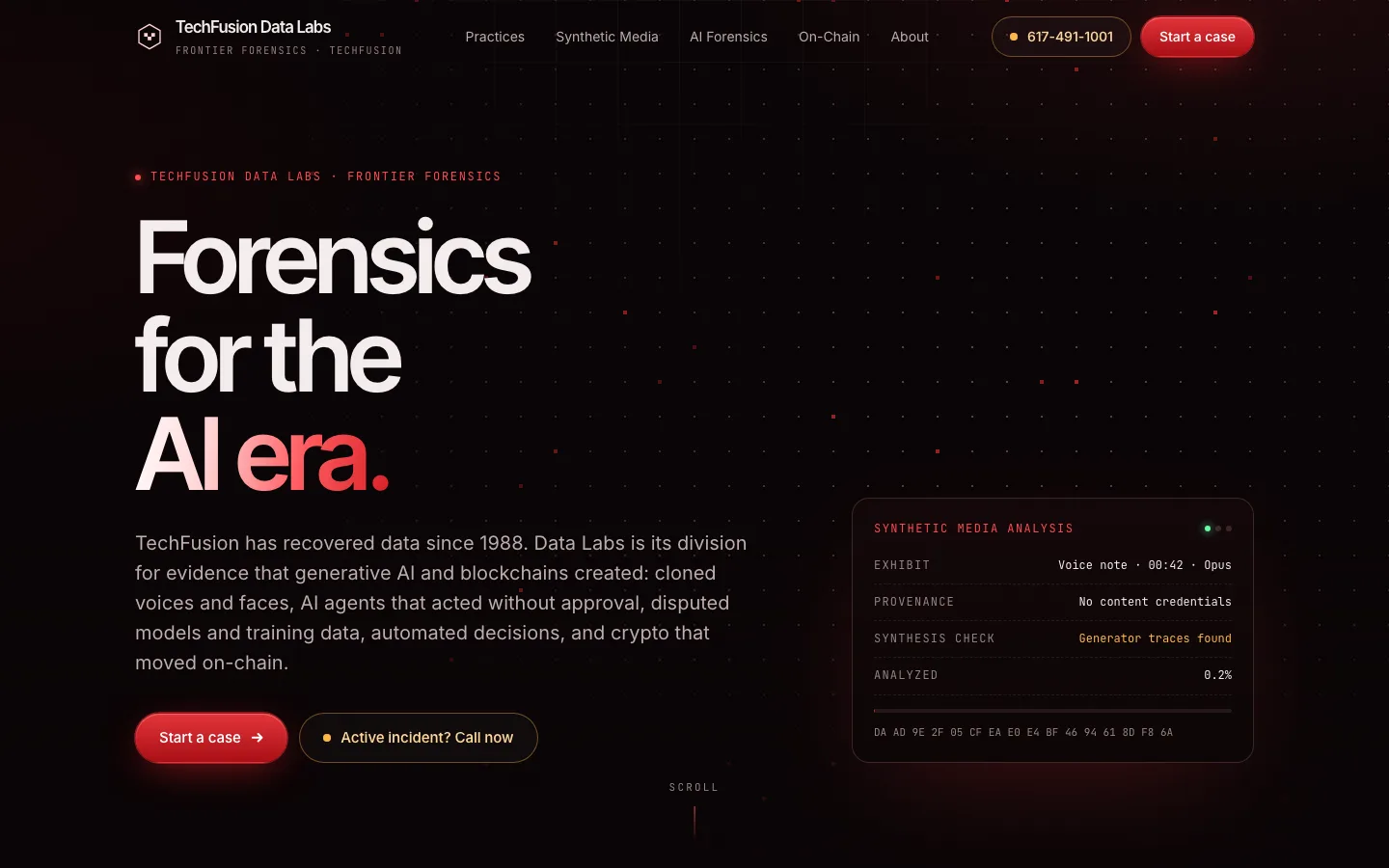
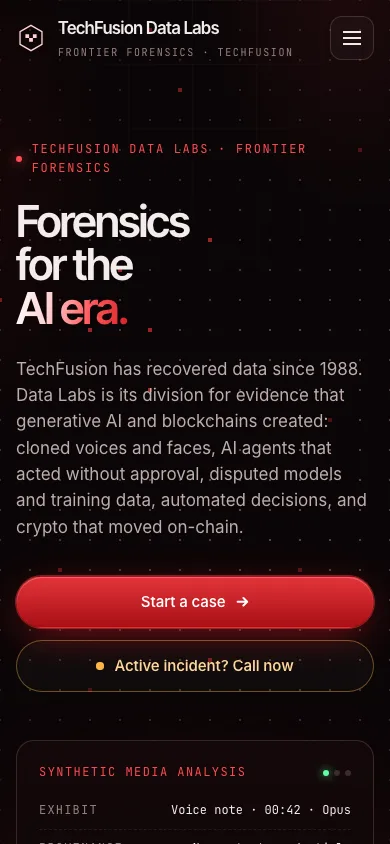
TechFusion Data Labs is the frontier forensics division of TechFusion, a Belmont, Massachusetts firm that has examined digital evidence since 1988. Data Labs is, in its own words, “its division for evidence that generative AI and blockchains created: cloned voices and faces, AI agents that acted without approval, disputed models and training data, automated decisions, and crypto that moved on-chain.”
The lab applies the discipline of classic forensics to new kinds of evidence: preserve first, analyze with several independent methods, and report findings with their confidence and limits stated. Everything TechFusion already offers, from data recovery to incident response, stays with TechFusion; Data Labs takes only the problems that are new.
- Part of
- TechFusion, examining digital evidence since 1988
- Practices
- Six forensic practices and four readiness programs
- Headquarters
- Belmont, Massachusetts
- Meetings
- By appointment in Boston, Cambridge, New York, Stamford and Washington, DC
- Round
- $4M Seed (2026), led by Caldrion Ventures
02The problem
The customer and the need.
The customer problem
“A voice can be cloned in minutes. An AI agent can take actions no person typed. A customer who passed every identity check may not exist.” The questions courts, boards and regulators ask haven’t changed (what happened, and can it be proved?), but the evidence has.
That evidence is also unusually fragile. AI providers purge conversations, platforms re-encode uploads and agent logs roll over, and the records of a single AI incident are often split between a company’s own application, its AI provider and the systems an agent called, each with its own retention period. Detection tools alone are not an answer either: detectors can be fooled and go out of date, and a single tool’s score is not a finding a court or regulator can rely on.
Who it serves
- Companies hit by deepfake fraud, such as cloned-voice payment requests or face-swapped executives on video calls
- Organizations whose AI agents, copilots or chatbots were hijacked or took actions nobody approved
- Model developers and rights holders in disputes over model provenance, training data or memorization
- Banks, fintechs, marketplaces and employers facing synthetic identities and attacks on selfie and ID checks
- Organizations using automated decisions to hire, lend, price or screen, and those challenging such decisions
- Victims of crypto theft and DeFi exploits, and the counsel, exchanges and courts who need a trace they can act on
Reports are written “to be read by a judge, a board or a regulator.”
03Product
The product in use.
Six practices, each dealing with evidence that generative AI or blockchains created:
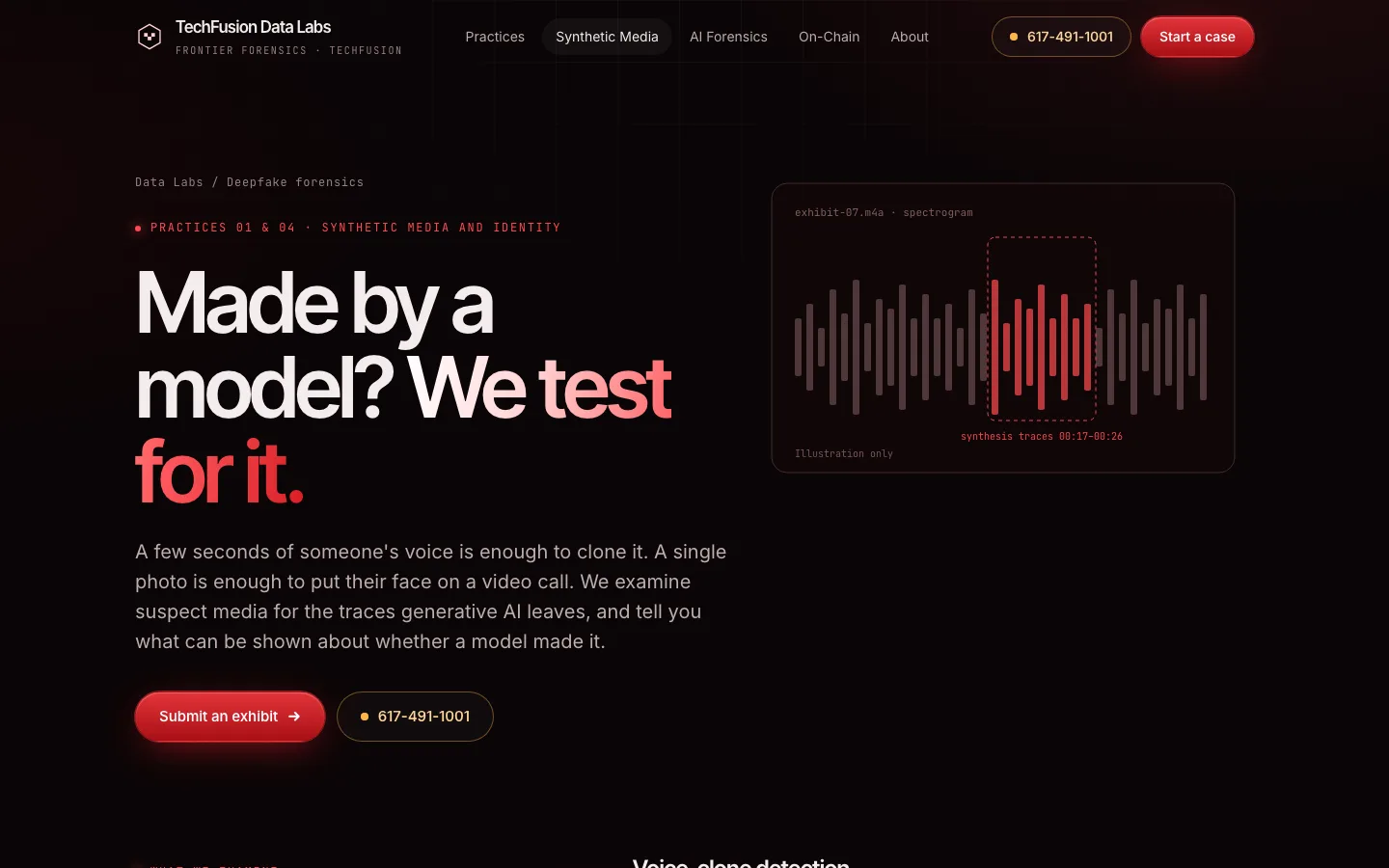
- Synthetic media detection. “Was this voice, video, image or document made or altered by a generative AI model?” Voice-clone, face-swap and lip-sync detection, AI image-generator identification, and verification of C2PA content credentials and AI watermarks.
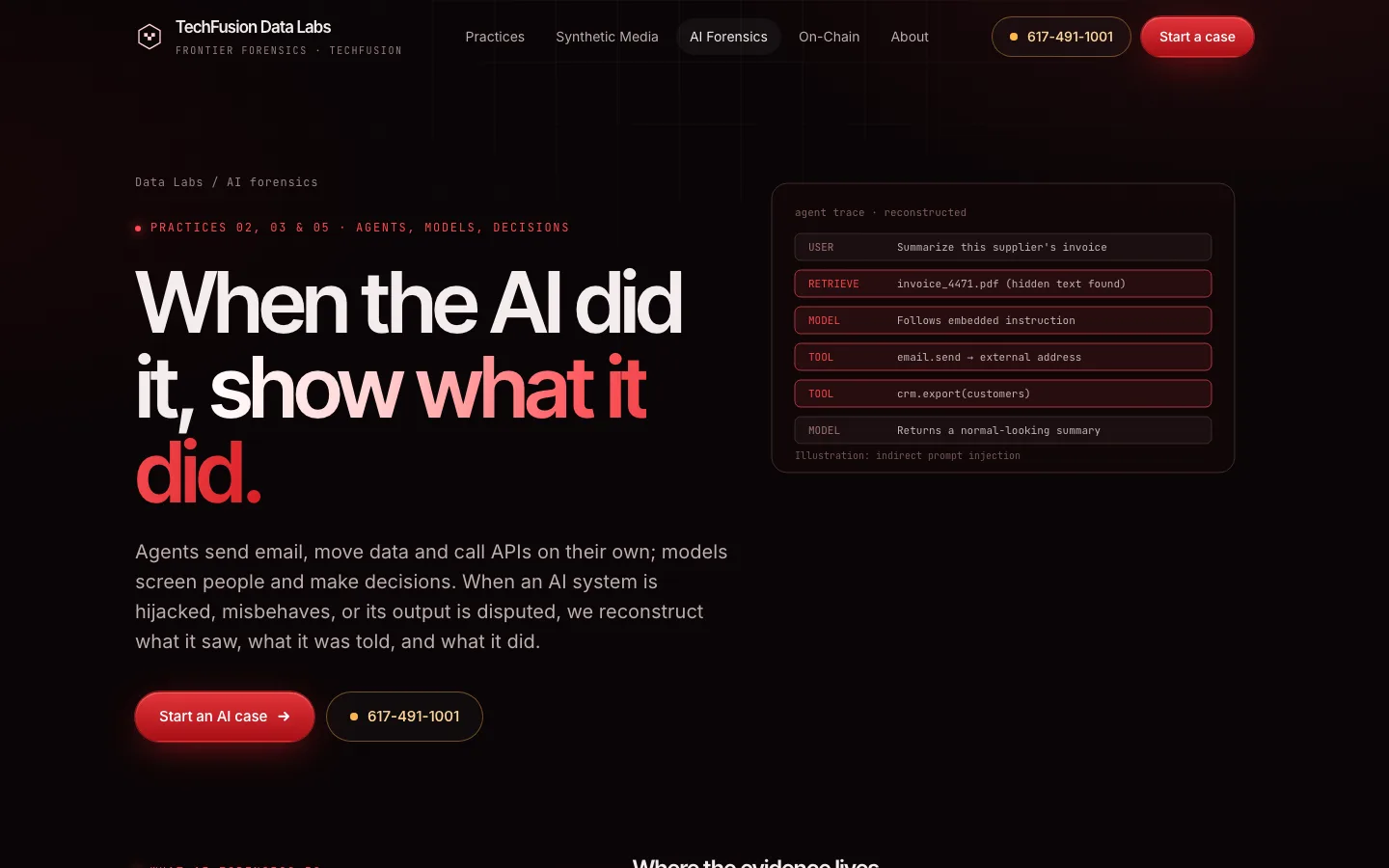
- AI agent forensics. “When an AI agent, copilot or chatbot is hijacked or takes an action nobody approved, we reconstruct what it read, what it was told and what it did”: prompt injection, guardrail bypass, run and tool-call reconstruction, poisoned retrieval and compromised plugins, including MCP servers.
- Model and training-data forensics. Model provenance and lineage, training-data membership testing, memorization testing and AI output source testing.
- Identity-verification attacks. Camera-injection and virtual-camera attacks, liveness and face-match spoofing, AI-generated ID documents and synthetic identity rings.
- AI decision forensics. Reconstruction of automated decisions, bias and disparate-impact testing, bias audits for automated hiring tools and model card verification.
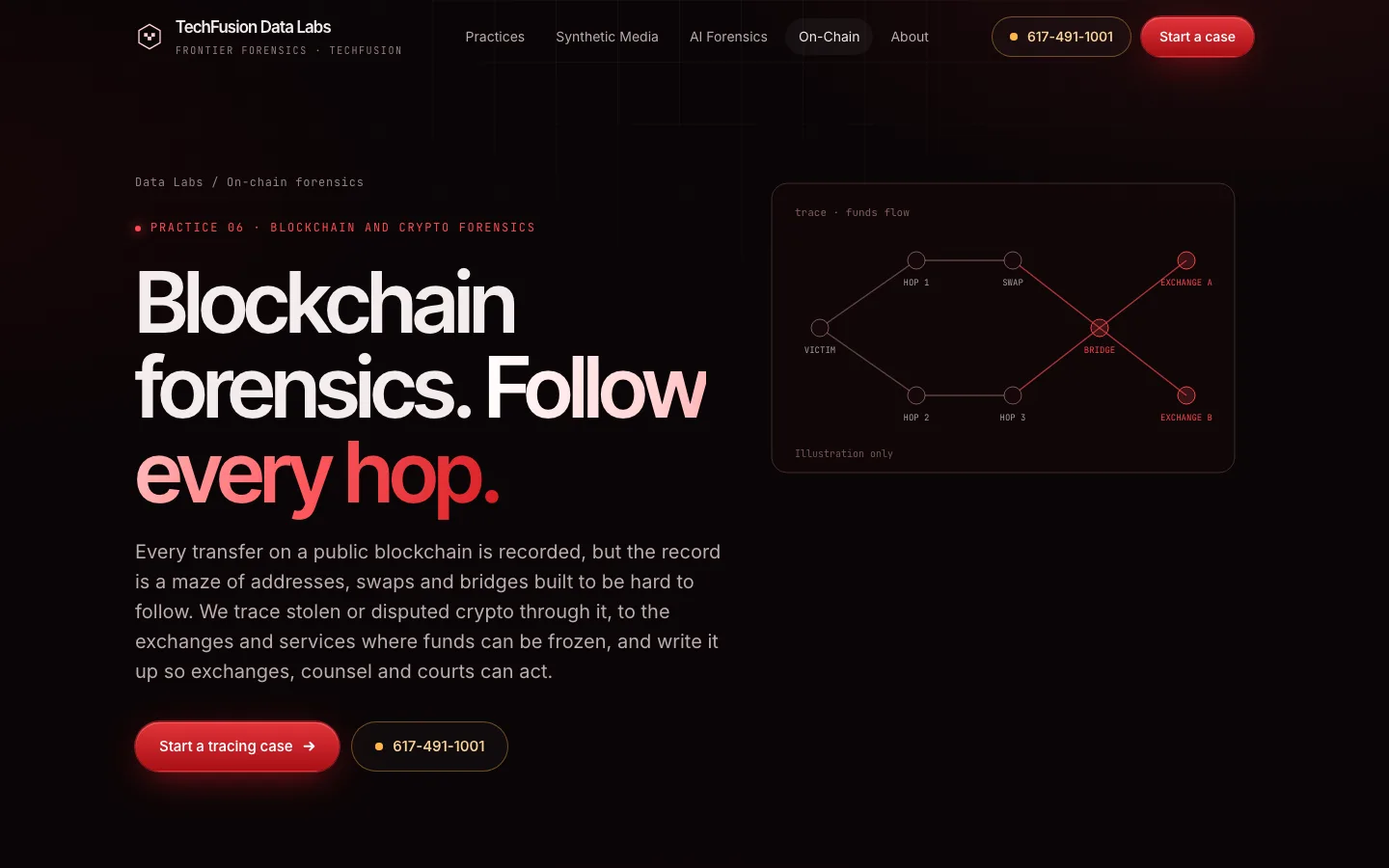
- On-chain forensics. Tracing across chains and bridges, linking addresses to exchanges and services, smart-contract and DeFi exploit analysis, and tracing reports for exchanges and courts.
Four readiness programs set things up “before it happens”: a deepfake response retainer with a named examiner on call, an AI agent traceability review, a content credentials program for signing an organization’s own media, and a recurring bias audit program.
How it works for a customer
- 01
Start a case
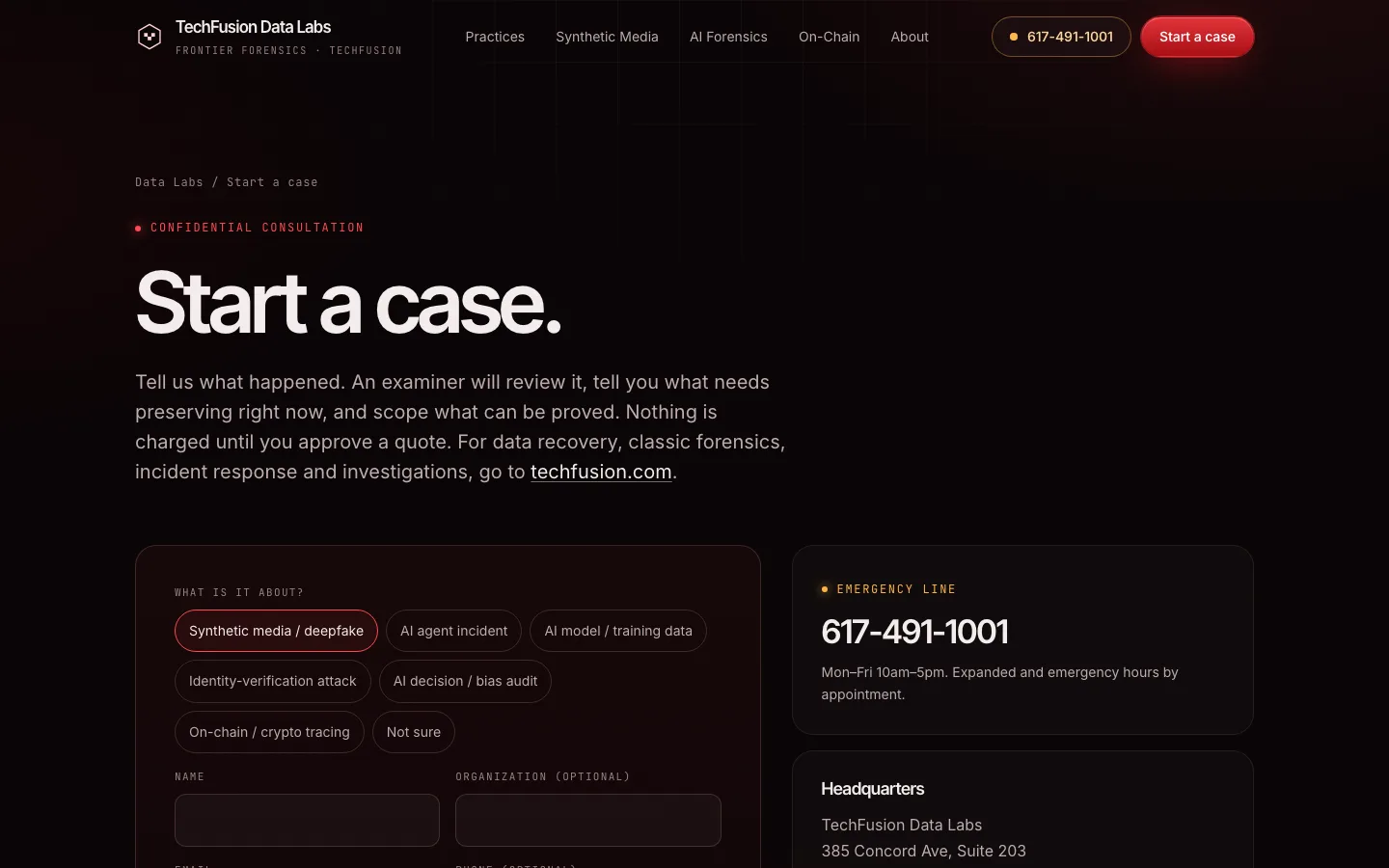
Describe what happened through the case form or the emergency line. An examiner reviews it and says what needs preserving right now.
- 02
A clear scope and quote
“A confidential first consultation, a clear scope and quote, and no work until you say go.”
- 03
Preserve and acquire
Original media, logs and model snapshots secured early, each hashed on arrival with a custody record.
- 04
Independent analysis
Several independent methods per question, with a human examiner on every finding.
- 05
A report that can be tested
Findings with stated confidence and limits, explained by the examiner who reached them.
04Opportunity and technology
Why it can win.
The opportunity
Generative AI and public blockchains have created disputes that classic digital forensics was not built for: synthetic media used for fraud, AI agents acting with real permissions, contested models and training data, automated decisions under legal scrutiny and fast-moving crypto theft. Each needs specialist methods, and each still ends in the same place, with evidence that has to hold up.
In our view, the firms best placed to answer these questions combine new technical methods with long-standing forensic discipline. Data Labs starts from TechFusion’s decades of chain-of-custody practice and adds the AI-era specialisms on top, with readiness programs that can turn one-off cases into ongoing relationships.
Technology
The lab’s methods follow the evidence. For synthetic media, it tests for the artifacts that text-to-speech, voice-conversion, face-swap and image models leave, and reads and verifies C2PA content credentials and AI watermarks, explaining “what their presence or absence does and doesn’t prove.” For AI agents, it rebuilds a run step by step from model, tool and platform logs; where anything is re-run, “it is a controlled copy, so the test can’t repeat the harm.” For models, it compares weights where available and behavioral signatures where they aren’t, and uses membership-inference and memorization testing. On-chain, it clusters addresses by shared funding and spending patterns and matches bridge and swap transactions on both sides.
Technology supports the examiners; it doesn’t replace them. “We use AI tools where they help and never let a single detector’s score stand in for an examiner’s finding.” Independent methods have to agree before the lab reports that a model made something, and every finding states whether it is direct or probabilistic, the method behind it and its limits.
05Trust
How evidence and case information are handled
Forensic work depends on evidence that can be trusted and on discretion. TechFusion Data Labs sets out its approach on its website:
- Chain of custody. “Every exhibit, log export and model snapshot is hashed and logged from arrival to return.”
- Methods disclosed. Each finding names its methods, its confidence and its limits, “so the other side can test it.”
- Humans decide. AI tools assist the examiners; a qualified person reaches and signs every conclusion.
- Confidential by default. NDAs on request, need-to-know access, encrypted delivery and secure disposal at close.
- No keys or passwords. Tracing works from the public ledger alone, and the lab never asks for seed phrases, private keys, passwords or wallet access.
Case details sent through the website are used to handle the case and are deleted from the site’s database two years after they arrive; the lab does not sell personal information. Read the full TechFusion Data Labs privacy policy (opens in a new tab).
06Where it is now
Stage and milestones.
TechFusion Data Labs launched its website in October 2026, with six practices, four readiness programs and a confidential case intake by form or emergency line. It operates from TechFusion’s headquarters in Belmont, Massachusetts, and meets clients by appointment in Boston, Cambridge, New York, Stamford and Washington, DC.
Caldrion Ventures led its $4M Seed round
Launched its website with six forensic practices and four readiness programs
Added a dedicated on-chain forensics practice for blockchain and crypto tracing
07Caldrion’s involvement
Our role at TechFusion Data Labs.
Portfolio investment · Seed · $4M · Led by Caldrion (2026) A company Caldrion Ventures has invested in. Where it has the same owner as Caldrion, its profile says so.
TechFusion Data Labs is a portfolio investment: a company founded and led by its own team, as the frontier forensics division of TechFusion.
Caldrion Ventures led TechFusion Data Labs’s $4M Seed round in 2026, from Caldrion’s own capital. Caldrion brings patient capital that is not tied to a fixed timetable, so the lab can build its practices at the pace its cases require.
Investors interested in investing directly alongside us: propose a partnership. Co-investors invest directly alongside Caldrion, never into a Caldrion vehicle.
Press and questions about TechFusion Data Labs: send us a message. Product and account questions go to techfusiondatalabs.com (opens in a new tab).
Insights
Related reading.
Investment perspective
Forensics for the AI era: why we believe TechFusion Data Labs will redefine what counts as proof
A cloned voice, a hijacked agent, a customer who never existed. Caldrion Ventures led the $4M Seed round for TechFusion Data Labs, the AI-era forensics lab, in 2026. Here is why we believe it can change how institutions establish the truth.
Caldrion Ventures