Somewhere right now, a salesperson is sitting in a parked car with the most important piece of information she will learn all week. The customer is ready to move, but only if the price holds until Friday. She knows it. Her manager does not. The CRM, the system her company pays for precisely so that this kind of fact is never lost, does not know it either, and will not until she gets back to a desk, if she remembers, if the day allows.
Multiply that moment by every call, every corridor conversation, every dinner where a discount was agreed and every flight boarded with a quote still waiting for approval, and you have the quiet, enormous failure at the heart of how businesses keep track of the people they serve. The record is supposed to be the truth, and most of the time it is a memory of the truth, written down late.
We believe that is about to change, and we believe Relay is the company that can change it.
Relay is a CRM platform, with sales, service, marketing, billing, analytics, automation and AI in one database, and a family of native apps for iPhone, iPad, Apple Watch, Android and Wear OS. Its own line says everything: “The CRM that comes to you.” Caldrion Ventures led Relay’s $3M Seed round in 2026, investing Caldrion’s own capital. This letter is our case for that decision, made in full and without hedging our enthusiasm: we think Relay rethinks its category from first principles, and we think the world it points toward is a better one for the people who do the work.
The record is supposed to be the truth
Start with what a CRM is for, stripped of every feature list. It exists so that a business remembers its customers: who they are, what was promised, what is owed and what happens next. Everything else, the reports, the dashboards, the automations, the forecasts, is downstream of one question: does the record match reality?
When it does, a CRM is one of the most powerful tools a business can own. A new hire inherits the full history of every relationship on their first morning. A manager sees the real pipeline, not a hopeful one. A customer who calls in angry is greeted by someone who already knows what went wrong. Promises get kept because they were written down where everyone can see them.
When it does not, a CRM is worse than useless, because people act on it. They chase a deal that already died. They miss the renewal that was mentioned in passing. They send the cheerful marketing email to the customer with the open complaint. The pipeline review on Monday becomes an exercise in archaeology, reconstructing what happened last week rather than deciding what to do this one.
In our view, the entire value of the category rests on that one property, the truth of the record, and the industry has spent decades building increasingly sophisticated machinery on top of a foundation that people do not keep current. That is not a criticism of anyone. It is a consequence of where the software lives.
Software that waits is software that loses
Here is the first-principles insight that Relay is built on, and that we find genuinely clarifying: the moments that change a customer relationship rarely happen in front of the software that is meant to record them.
They happen on a call taken while walking between meetings. They happen in the lobby after a demo, at a site visit, in the five minutes before a flight closes its doors. The person who learns the fact is almost never sitting at a desk with a browser tab open to the right record. So the update waits. First until the end of the day, then the end of the week, and then, often enough, forever.
The conventional response has been to treat this as a discipline problem. Managers send reminders. Companies tie compensation to data hygiene. Consultants run training. We think this misdiagnoses the problem entirely. If a system asks people to come to it, they will come late. If it comes to them, at the moment of the call, the meeting or the decision, with one clear action, the record stays true almost as a side effect.
That inversion is the whole idea, and it is why we find Relay so compelling. It does not ask people to be more diligent. It changes where the software meets them. The product brief puts the division of labor in a single sentence we have come to love: “The website is where a business is set up; Relay is where you run your day: who needs you, what’s next, what changed, and what’s waiting for your yes.”
The website is where a business is set up. Relay is where you run your day.
Read that sentence twice and the strategy reveals itself. Configuration is occasional, deliberate and complex; it belongs on a big screen. Running the day is constant, interrupted and urgent; it belongs on the device that is always with the person. Most of the category, in our view, built one tool for both jobs and asked the person to adapt. Relay builds for the person and lets each surface do what it is best at.
Why the desk-shaped model can’t simply follow
The natural objection is that this is obvious, and that established CRMs will simply build better mobile apps. We take the objection seriously. We think it underestimates how deeply a product’s origins shape what it can become.
The CRM category grew up on the desktop, and its architecture still shows it. In our view, the dominant model was designed as a configurable database first: objects, fields, views and reports, built to be administered. That design has real strengths. It is flexible, it scales to very large organizations, and it supports a broad ecosystem of partners and integrations. Those strengths are also commitments. A product organized around the database will tend to put the database at the center of every screen, because that is what its data model, its customers’ configurations and its whole surrounding ecosystem expect.
Mobile, in most of the category, arrived later and as a smaller window onto that same database. You can look things up. You can edit a field. But the app rarely knows what your day looks like, what is waiting for you, or what you should do next. A smaller screen onto a desk-shaped system is still a desk-shaped system.
Retrofitting a person-first experience onto that foundation is not a matter of hiring a better mobile team. It means deciding, at the level of the data contract, what a day is, what “needs you” means, how a decision is presented with its context and its risk, and what happens when the person has no signal. Those are architectural choices, and in our experience architectural choices are the hardest thing for a successful product to revisit, precisely because so many customers depend on the old ones.
At the other end of the market, simpler tools have won smaller teams by being easier to start with. Many stop short of what a growing business genuinely needs: service tickets with response targets, quotes and invoices, approvals, permissions, an audit trail. Businesses end up stitching several products together, which pushes the record further from reality, not closer.
We see a wide opening between those two worlds, and we believe Relay is built to own it: the depth of a real business platform, delivered through an experience designed from the person outward. That is a product problem far more than a sales problem, and product problems are exactly what the Caldrion studio exists to solve.
Why now: AI turns the CRM from a ledger into a colleague
Great ideas fail when they arrive early. We believe Relay arrives at precisely the right moment, and the reason is the most important shift in business software in a generation.
Until recently, a CRM could only store what people typed into it and remind them of what they had already decided. It was a ledger: faithful, passive and entirely dependent on human input. Generative AI breaks that limit. Software can now read a customer’s history and summarize it before a meeting, draft the follow-up after one, notice that a deal has gone quiet, and propose the next step. For the first time, the system can do the preparation, and the person can do the deciding.
That changes what the interface is for, and this is the part we think many observers have not yet absorbed. If the software prepares the work, the person’s job is no longer data entry. It is judgment: approve this quote, send this reply, move this deal, call this customer back. Judgment is exactly the kind of work that fits a phone or a watch, in the gaps between meetings, as long as each decision arrives with its context and a single, safe action.
Put the two ideas together, a CRM that comes to the person and AI that prepares the work, and they reinforce each other powerfully. AI without a great decision surface produces a backlog of suggestions nobody reviews. A great mobile surface without AI is still asking people to type. Together, they move the center of gravity of the CRM from the desk to the hand. The desk remains the place to set up a business, design its pipelines and build its reports. The day itself, we believe, will increasingly be run from a device that is always within reach.
Relay was designed for that division from its first brief. It is not adapting to the shift; it was born inside it.
The yes: the rule that makes AI safe to unleash
Every investor in applied AI has to answer an uncomfortable question: what happens when the model is wrong?
In a CRM, the stakes are unusually high. An agent that can draft an email can send one. An automation that can update a deal can close it. A model that misreads a customer’s message can damage a relationship that took years to build, in seconds, in the business’s own name. We think many businesses will hold back from AI in their customer systems not because the technology is weak, but because they cannot see or control what it does.
Relay’s answer is, in our view, one of the most important product decisions we have seen in this wave of software, and it is written into the foundation as a single rule: agents and automation draft and propose; anything that reaches a customer, publishes, moves money, merges or deletes waits for a person, unless a person deliberately switches on automatic sending for a workspace. Waiting actions go to an approvals inbox, and Relay puts that inbox in a person’s pocket, with the reason, who asked and the risk, so that “yes” or “no” takes seconds.
AI proposes. People decide. Relay makes the deciding fast.
The discipline runs all the way through. Relay signs in as the person, never as an agent: it can do exactly what that person can do on the website, under the same rules, and anything that needs approval says so before and after. The audit log records the device a change came from, so a business can see that an action was taken by a named person via Relay on their phone. AI agents in the CRM work inside one workspace at a time; they cannot change certain sensitive facts about a customer, such as a company’s domain, and their emails always wait for approval. Agents started by outside events get no web tools. Notes and sensitive properties never leave the console for agents or the API. And the assistant, Ask Relay, which runs on Claude, by Anthropic, asks permission before the first question is sent.
We want to be emphatic about why this matters commercially, not just ethically. We believe trust will be the gating factor for AI adoption in customer systems, and that the businesses which adopt AI fastest will be the ones that can see what it proposes, approve what matters and audit what happened. A rule like Relay’s does not slow AI down. It is what lets a business say yes to more of it. A CRM that is trustworthy by design can let AI do more, not less, and we think that is the core proposition for the next decade of business software.
There is a deeper idea here too. As AI does more of the preparation, the scarce and valuable thing becomes the moment of human judgment. Relay is, in a sense, a product built entirely around that moment: making it informed, making it fast, and making it accountable. We think that is exactly the right thing to build around.
A day in Relay
Theses can be abstract. Products are not. So let us describe what a day looks like in Relay, using what the apps actually do today.
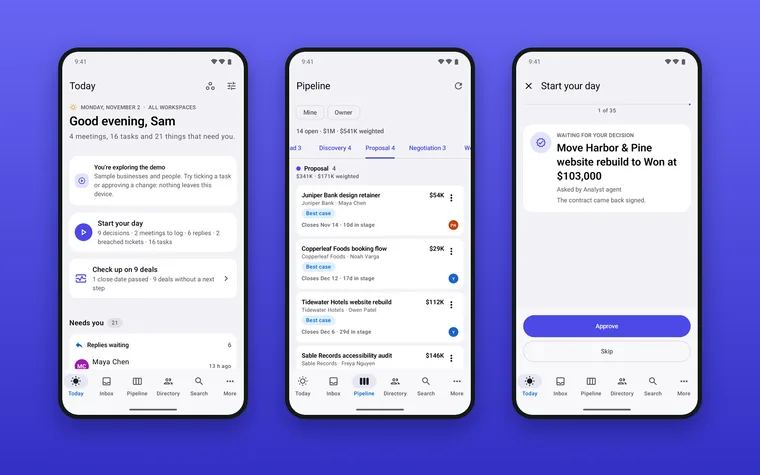
Morning. The person opens Today: a greeting, the date and a one-line tally of meetings, tasks and what needs them. Below it, meetings, tasks due and follow-ups sit on one timeline, with a Needs you section gathering replies waiting, approvals, breached tickets and overdue invoices, and saying “Nothing needs you right now” when that is true. A single button, Start your day, turns all of it into a full-screen run-through, one card at a time: decisions, people who replied, meetings to log, breached tickets, overdue then today’s tasks, the next meeting’s brief. Each card has one action and a Skip. It ends honestly, saying “You’re caught up” only when nothing was skipped. It can be launched from Siri: “Start My Day.”
On a Monday, Deal check-up surfaces the deals that need a look, and says why: the close date passed, there is no next step, or the deal has sat in a stage longer than the workspace’s usual. Keep in touch shows who is due a check-in. Before leaving the office, Take today offline fetches what the day needs, so it opens without signal.
Between meetings. Fifteen minutes before a meeting, a notification and a Live Activity bring the brief: who, their company, the last touch, open deals and the suggested next step. On Apple Watch, the same brief is a glance at the wrist. An approval arrives with Approve and Reject buttons right on the notification; the decision takes seconds and lands in the audit trail under the person’s name.
On a call. The person taps a phone number in Relay. Coming back mid-call, they see the person’s open deal, its next step, the last touch and the stage’s playbook as “Cover” and “Ask” lists to tick, with notes typed during the call kept on the device. When they hang up, Relay offers to log the call with its duration, pre-filled with those notes and an outcome suggested from the call’s length. Nothing is recorded.
In the field. Near an account, the Nearby map offers to check in at the account, and one tap logs the visit. Location is used only while the screen is open and is never stored or sent. A business card is scanned into a new person, with the company matched by domain. A note is dictated on the walk back to the car.
After the meeting. About two minutes after it ends, Relay asks “How did it go?”: an outcome, a note, an optional follow-up task, and the meeting is logged. The loop closes while the memory is fresh, and the record stays true.
Friday afternoon. Your week shows what got done and what is coming up, every figure a count of what the CRM actually answered, saying “at least” when a list is bounded and admitting when a part could not load rather than showing zero.
That is the product thesis made concrete. Not a smaller website, but a day, organized around a person, with the CRM doing the remembering. Every one of those moments is a moment where, in most tools, the record would have drifted. In Relay, it is where the record gets written.
What exists today, and why it impresses us
Enthusiasm is only worth something if it rests on substance, so we want to be precise about what is built.
The platform is real and deep. The CRM behind Relay is live as its own service on Cloudflare Workers, with a web console, a REST API, an MCP server for AI agents, and the app API that Relay uses. It covers records, sales, service, marketing, billing, analytics, and automation and AI, with permissions, approvals and an audit log. Sales includes a prioritized work queue, a call queue, sequences, templates, quotes with approval rules and online acceptance, a meeting scheduler and the forecast. Service includes a help desk fed by email, chat, forms and a customer portal, with response-time targets that count business hours, a knowledge base and surveys. Billing runs one-time and recurring invoices from quotes and subscriptions. Analytics includes a report builder, dashboards, attribution and funnels. Automation and AI includes a workflow builder, agents and the assistant.
The unglamorous foundations are done properly. Permissions reach down to individual records. Writes are idempotent, so a retry never charges or sends twice. Anything a customer could have typed, through a form, a chat or an email, only fills blank fields on an existing person and never overwrites what a member of the team entered. Scheduled work is claimed before it starts, so overlapping runs never repeat a send or a billing period. The platform carries thirteen automated test suites. These are the kinds of details that real businesses depend on and that, in our experience, young companies tend to postpone. Relay did them first.
The apps are genuinely native, on every device. The Apple apps are written in Swift and SwiftUI for iPhone, iPad and Apple Watch, with no third-party packages; the Android app is written in Kotlin and Jetpack Compose for phones, tablets, Chromebooks and Wear OS, with no cross-platform framework. Each device has its own job:
- iPhone is the person’s day: Today, the Inbox, the Pipeline as a stage pager with the forecast, the Directory, and things only a phone can do, from logging the call you just made to scanning a business card.
- iPad is the command center: every console section in a sidebar, the pipeline as a full board with drag and drop, dashboards, tables, keyboard shortcuts and several windows.
- Apple Watch is the nudge: the next meeting’s brief, today’s tasks with a tap to complete, approvals decided on the wrist, and complications.
- Android and Wear OS bring the same product to Android phones, tablets, Chromebooks and watches, with widgets, Quick Settings tiles and a Wear OS tile, on the same API.
Around them sits the whole system experience: Home and Lock Screen widgets, Live Activities for a call, a ticket’s response-time countdown and meeting prep, push notifications with actions, Siri and Shortcuts, Spotlight, Handoff and Focus filters on Apple devices.
Privacy is part of the product, not a page in the settings. No ads, no analytics, no crash-reporting services, location kept on the device, an optional lock, a Discreet mode that hides money and personal details when presenting, and a full wipe of what Relay kept when a person signs out. Relay works offline, keeping what a person has seen and holding changes in an outbox until they sync, each change going once, under the account that made it.
Anyone can see it. A demo with two fictional workspaces runs the whole app without an account or a network, and sends nothing.
As for stage: Relay for Android has been approved and live on Google Play’s closed testing track since November 3, 2026, for testers only. The iPhone, iPad and Apple Watch apps first compiled in October 2026 and are being prepared for App Store review; nothing has been submitted yet. Relay is a company in its building stage, and we invested on that basis, with our eyes open and our conviction high.
The team’s thinking is the asset
Relay is studio-founded. It was originated and built by the Caldrion Ventures studio, whose product, engineering, design and AI teams continue to build it. We know the work intimately, which is both an advantage and a reason for discipline. We have tried to judge it the way we would judge any company at this stage: by the quality of the decisions it has already made. Those decisions are, frankly, what excite us most.
The bar was set at the top, and written down. The product brief for the Apple apps aims at the standard of an Apple Design Award, and names the qualities it competes on: interaction, visuals and graphics, innovation and inclusivity. It asks that every screen “feel inevitable, calm and fast, with the depth of the website one tap away.” The apps were written and reviewed over ten review rounds, covering correctness, navigation, visual design, interaction, accessibility, performance, the system experience, delight, trust and App Store readiness. Text has to work at every Dynamic Type size, up to the largest accessibility sizes. Teams that write down their standard and review against it tend to keep it, and we believe craft at this level is a strategic weapon, not a luxury.
The hard parts were done first. It is easy to build a pleasant mobile front end on a thin back end. Relay did the opposite. The platform carries the work businesses depend on, and the apps share an API contract and a set of tests that define behavior on both platforms, so Android ports Apple’s logic rather than guessing at it. Even the demo is shared: the Android demo uses the same workspace, exported from the Apple codebase.
Honesty is designed into the product. This may be our favorite thing about Relay. The Google Play listing claims only what was checked in the app and deliberately leaves out what is not ready. The CRM’s documentation lists, openly, what it has not built and why: telephony, calendar sync and several messaging channels among them. The apps’ weekly summary says “at least” when a count is bounded, and a section that could not load says so rather than showing zero. Start your day only says “You’re caught up” when nothing was skipped. A product that refuses to overstate itself earns a kind of trust that marketing cannot buy, and in a category whose entire value is the truth of the record, we think that habit is foundational.
Restraint is a feature. Cards on Today draw nothing when they have nothing to say. Tips appear at most once a day. The Report a problem screen shows the person exactly what would be included, never names, records or messages, and sends nothing automatically. These are small choices. Taken together, they describe a team that respects the person’s attention, and we believe attention is the scarcest resource in modern work.
Why this approach compounds
The best companies are not just good on day one. They get structurally better with every month that passes. We believe Relay has several such loops built into it.
Truth compounds. Every call logged at hang-up, every meeting closed out two minutes after it ends, every approval decided on the wrist makes the record a little more accurate. A more accurate record makes Today, Deal check-up and Keep in touch more useful. More useful surfaces get opened more often, which keeps the record more accurate still. This is a flywheel that desk-bound software, in our view, struggles to start.
AI compounds on truth. Assistants and agents are only as good as the context they are given. A CRM whose record is current gives AI better material to summarize, better signals to notice and better histories to draft from. We expect that as models improve, the businesses with the truest records will get the most from them, and Relay is designed to produce exactly that kind of record.
Trust compounds. Each approval decided quickly and audited cleanly makes a business more comfortable letting AI prepare more. The rule that people approve consequential actions is not a ceiling on AI; it is the mechanism by which a business can safely raise its expectations of AI over time.
Craft compounds. One API contract, shared tests and a shared demo mean that every improvement to the platform is available to every surface, and every journey can be checked without a real account. A team that has already invested in this structure can, we believe, move faster on five platforms than a team that has not can move on one.
Platform and app compound together. Mobile-first tools tend to lack depth; deep platforms tend to treat mobile as an afterthought. Relay has both, built by one team, against one contract. We believe that combination is far harder to copy than either half alone, and that the gap widens as each half improves the other.
What we believe others miss
The reflexive objection to a new CRM is that the category is crowded and the incumbents are entrenched. We think that view reads the past accurately and the future poorly.
First, the interface is becoming the product. When software does most of the preparation, the difference between CRMs will be less about how many fields they can hold and more about how well they put the right decision in front of the right person at the right moment. That is a design problem, and it rewards products built for it from the start.
Second, trust will decide AI adoption in customer systems. We expect businesses to adopt AI fastest where they can see what it proposes, approve what matters and audit what happened. A product whose architecture assumes a person approves every customer-facing action is better placed for that world than one that adds controls afterward.
Third, native craft is a moat in mobile work software. Many business apps are built once and shipped everywhere through a cross-platform layer. That is economical, but such apps rarely feel at home on any device. Relay chose two native apps, with widgets, Live Activities, Siri and Shortcuts on Apple devices, and widgets, tiles and Wear OS on Android. It is more expensive to build. It is also, in our experience, the difference between software people choose to open and software they are told to use.
Fourth, the person is the unit of adoption. Business software is bought by organizations, but it is used, or quietly avoided, by individuals. We believe the CRM that wins the next decade will be the one people actually want in their pocket, because the value of the record depends on them. Relay is the first CRM we have seen that is designed, end to end, around that person.
The world if Relay succeeds
Allow us, for a moment, to describe the future we are investing toward. This is vision, not forecast, but it is the vision that made us lead this round.
Imagine a business where nobody updates the CRM, because the CRM is never out of date. Where the call is logged when it ends, the meeting is closed out while it is fresh, and the follow-up is drafted before the person has reached the elevator. Where Monday’s pipeline review is about decisions, because the facts are already true.
Imagine a business where AI does the tireless preparation, reading histories, noticing quiet accounts, drafting replies, and every action that touches a customer still passes through a human yes. Where a founder approves a quote from a departure gate in seconds, with the reason and the risk in front of her, and the audit trail records exactly who decided and from where. Where the question “what did the AI do?” always has a clear, checkable answer.
Imagine the people inside that business. The service lead who walks into a hard conversation already knowing what went wrong. The field rep who spends the day with customers instead of with forms. The owner who stops carrying the whole company’s commitments in their head because the system finally carries them instead. We believe Relay can give people back the hours and the attention that record-keeping has quietly taken from them, and return them to the work that only people can do: listening, deciding, keeping promises.
And imagine what that means for customers. Promises remembered. Follow-ups that actually follow up. Problems noticed before they become complaints. In our view, a truer record is not just an efficiency gain for the business; it is a better experience for every person the business serves.
We believe the next great CRM will not be the one with the most fields. It will be the one people trust to keep their promises.
That is the change we think Relay can make in how people and institutions work: from systems people serve to systems that serve people; from AI that acts in the dark to AI that proposes in the open; from a record written late to a record that is simply true. We think that is worth building, and we are proud to back the team building it.
The risks we take seriously
Conviction is not certainty, and we would not respect a thesis that hid its risks. These are the ones we underwrote, and how we manage them.
Distribution. Relay today serves people who work in a business’s Caldrion CRM, and accounts are created by that business. The App Store plan recognizes this directly: it recommends an unlisted release for now and a public listing only once other businesses can get CRM accounts. Opening the platform to businesses beyond the studio is the central commercial question for Relay. We underwrote it by setting aside capital for that work explicitly, and we will measure it from the first outside customer, with patient expectations for the timing.
Execution across five platforms. iPhone, iPad, Apple Watch, Android and Wear OS is a broad surface for a young company. The Apple build is not yet green in continuous integration, push notifications on Android are not yet built, and several sections on Android still show “Soon.” The mitigation is the structure already in place: one API contract, shared tests that define behavior, a phased Android roadmap with exit criteria at each step, and a demo mode that lets every journey be checked without a real account.
Platform and model dependence. Relay depends on Apple and Google for distribution and notifications, and on a third-party model for its assistant. We regard these as manageable: the apps follow each platform’s rules closely, the assistant is optional and asks permission, and the rule that people approve consequential actions limits the cost of any model’s mistake.
Scope. The CRM’s documentation lists capabilities it has deliberately not built, from telephony to calendar sync. Some customers will want them. We see the honest list as a strength, and we expect the team to add what real customers ask for, in the order they ask for it.
Trust. A CRM holds a business’s most sensitive relationships. One serious lapse could be costly. Relay’s privacy choices, its threat model and its approach to customer data are documented, and Caldrion’s privacy policy sets out what the app sends and keeps. We will hold the company to that standard at every stage.
What the round funded, and how we will measure it
The Seed round was sized to take Relay from a product that works to a company that serves customers. In qualitative terms, it funded four things, each grounded in work the team had already planned.
Release on Apple devices. Getting the build green, signing the apps under Caldrion LLC, enabling push notifications and universal links, and taking the iPhone, iPad and Apple Watch apps through App Store review.
Parity on Android. Completing the Android roadmap: the core journeys tested on phones, adaptive layouts for tablets and foldables, the remaining sections, push notifications, and the Wear OS app on Google Play.
Opening the platform. The work needed before businesses beyond the studio can get accounts on the CRM and use Relay: onboarding, support and the operational care a customer-facing platform requires.
Depth where it counts. Continued investment in the assistant and the approvals experience that make Relay distinctive, and careful choices about which deliberately deferred capabilities earn a place as real customers ask for them.
We are deliberately not stating budgets or headcount. What matters is that the round was sized for a phase of building and learning, and that Caldrion’s capital comes with no pressure to scale ahead of the evidence.
We would consider Relay a success if a business that runs its customers on it would not willingly go back: if its people start their day in Relay rather than in their inbox, decide approvals in seconds rather than hours, and trust the record because it is kept current where the work happens. Along the way, we will judge progress by evidence rather than headlines:
- Release. The Apple apps live through App Store review, and Android at parity on the core journeys, with push notifications on both.
- Adoption. Businesses beyond the studio running their customer work on the platform, and how quickly a new business reaches its first useful day.
- Daily use. Whether people open Relay every working day, use Today and Start your day, and act from it rather than only reading.
- Decisions. How much of a business’s approval and follow-up work is done from the apps, and how long decisions wait.
- Trust. Retention of the businesses that adopt it, the quality of the record they keep, and a clean record on privacy and security.
None of these is a promise of an outcome. They are the questions we will ask, together with the team, at every stage.
Why we led, and why we would lead again
We led this round because we believe three things deeply. We believe the CRM is moving from the desk to the hand. We believe AI will be adopted fastest where people stay in control of what it does. And we believe Relay was designed for both from the first line of its brief, by a team whose standards, honesty and craft we would put against anyone’s.
Some companies make a category a little better. A few change what the category is for. We believe Relay is one of the few: a CRM that stops asking people to serve the database and starts serving the people, with AI that prepares the work and a human yes at every moment that matters.
Caldrion invests only its own capital, with no fixed timetable to return it. That lets us give Relay what this opportunity rewards most: the time, the capital and the focus to reach the businesses it was built for. We are thrilled to be on this journey, and we cannot wait for the day the CRM finally comes to everyone.
— Caldrion Ventures
This letter reflects Caldrion Ventures’ views as of November 2026. It is not an offer of securities or investment advice.