Earlier this year, Caldrion Ventures led the $1.5M Seed round of Fitness Jesus. Fitness Jesus was originated and built by our studio, and we committed Caldrion’s own capital to take it further because we believe, with real conviction, that it is one of the most quietly radical consumer ideas we have seen: a product that goes after the single most wasteful moment in the whole business of getting people to move, and fixes it with something almost nobody in the category has been willing to build. The truth, checked and dated.
This letter is long because the idea deserves it. It sets out what we believe, why we believe it, what we think the rest of the market has missed, why we expect this approach to compound, and the world we think becomes possible if Fitness Jesus succeeds. It also sets out, plainly, the risks we take seriously, because conviction that cannot survive its own risks is not conviction. It is hope.
The most expensive moment in fitness
Picture someone in New York City on a Tuesday night. They have decided, really decided, that they want to start moving. Maybe it is a new year, maybe a new job, maybe a doctor’s nudge, maybe just a long winter. The motivation is there. The willingness is there. And then they open a browser.
What they meet is a wall. Studios, gyms, clubs, classes, leagues, parks programs, run crews, climbing walls, reformer rooms. Each with its own pricing shape. Each with its own booking system. Each with its own unwritten rules about what happens the first time you walk through the door. Is the “intro offer” really an intro offer, or the first step into a commitment? Will the boxing class humiliate me? Will the running club leave me behind on the first mile? Is the studio on that listing even still open?
Most people, faced with that wall, do the rational thing. They close the tab. They decide to “look into it this weekend.” And the intention that was so clear on Tuesday night quietly dies.
We believe this is the most expensive moment in fitness: not the moment someone quits a gym in March, which the industry obsesses over, but the moment before they ever start, when a willing person meets an unanswerable question and walks away. It is expensive for that person, who loses the thing they had decided to do. It is expensive for every studio, club and city program that would have welcomed them. And in our view it is expensive for a society that spends enormous energy encouraging people to be active and comparatively little making the first step easy.
Fitness Jesus exists, in its own words, “to answer one question fast: what should I do, where, and how much is it? In New York City, for now.”
The fitness industry is built around the people who already crossed the wall. Fitness Jesus is built for the person standing in front of it.
A first principle: certainty, not willpower
When we strip the problem to its foundations, we arrive at a claim that we believe much of the category has gotten backwards.
Starting to move is mostly a problem of choice and confidence, not motivation.
The industry has spent decades selling motivation. Motivation is real and it matters. But motivation is not what most people at the edge of starting are short of. They are short of certainty: about where to go, about what it will cost, about what the first time will feel like, about whether people like them are welcome.
Here is why this matters so much. Willpower is not something software can sell. Uncertainty is something software can eliminate. Uncertainty is an information problem, and information problems are solvable, with care, discipline and good engineering. The moment you see the first step as an information problem rather than a character test, a whole new kind of product becomes possible: one that does not try to change who you are, but simply tells you, honestly and fast, three real places you could go tonight, what each one costs to try, and how to get there.
That is what Fitness Jesus does. And we believe it is exactly the right shape for the problem.
The house voice says it perfectly. Fitness Jesus describes itself as “a friend with a list, not a guru.” Its style is “short, warm, funny for beginners, never judging,” and its about page promises never to “make anyone feel judged for being new, slow, or starting again.” This is not a brand flourish. It is a product thesis. The person standing at the wall is often a little afraid. A guru adds pressure. A friend with a list removes it.
What Caldrion’s studio built
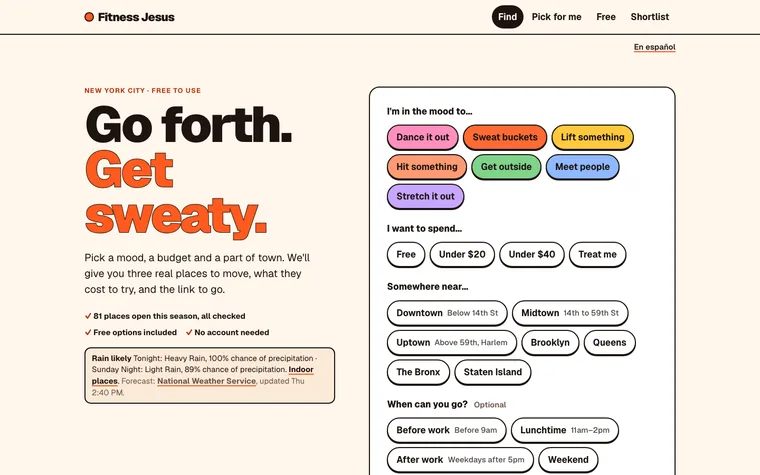
A visitor to fitnessjesus.com (opens in a new tab) meets a single, confident sentence, “Go forth. Get sweaty.”, and three simple choices.
A mood. Seven of them, each with a line that tells you exactly what you are signing up for: “Dance it out” (music loud, choreography forgiving), “Sweat buckets” (hard, fast, done in an hour), “Lift something” (weights, racks, getting stronger), “Hit something” (bags, gloves, climbing walls; “good for a bad day”), “Get outside” (parks, rivers, actual daylight), “Meet people” (clubs and crews that say hello back) and “Stretch it out” (yoga, Pilates, a long exhale).
A budget. Four, from Free to “Treat me.”
A part of town. Downtown, Midtown, Uptown, Brooklyn, Queens or the Bronx.
Optionally, a time of day (before work, lunchtime, after work, the weekend) and anything the visitor needs: low-impact sessions, classes for older adults, Spanish-language classes, wheelchair access, childcare, an intro or beginner option, or an indoor setting. And there is a checkbox we love: “I’m new to this. Be gentle.”
Press the button and Fitness Jesus returns three real places that fit, says in plain words why each one fits, shows what it costs to try, and sends the visitor straight to the place’s own schedule to book. Pick for me chooses one at random for anyone who would rather not decide at all. There is no account, no sign-up and no paywall.
Around that finder, the studio built something far bigger than a search box. There is a directory of every place. There are place pages covering the price to try, where and when, what to expect, “Before you go” practicalities, “How hard?” in the provider’s own words, the next session with Add to calendar, the pages that were checked and the date, and a link to report a correction. There is an “Everything free” page, and a “Free this week in the parks” page that reads free NYC Parks fitness sessions from the city’s own public events feed. There is a “This week” page of dated things only: free classes, club meets, intro offers about to end, and the places re-checked that week. There is a weekly dare (“Try one thing you’d never pick. Nobody’s watching. That’s the point.”).
There are first-time guides that walk through what actually happens at a first boxing or jiu-jitsu class, climbing session, reformer class, dance class, group run, pickup game or lap swim, and even one for visitors to the city. There is a “Your first two weeks” plan that picks four real places by plain rules: something free, an intro offer, something social and a stretch, with their next dates. There is a cost calculator that works out the cheapest published way to go a given number of times a month, and an explainer of how paying to move actually works, from drop-ins to packs to memberships to league fees. There is a shortlist that lives in the visitor’s own browser and can be shared by link and compared side by side, a map of every place, neighborhood pages, a Spanish-language version, and a page of what has changed or paused.
And then there is the line from the about page that we think captures the company’s character better than anything we could write:
“The joke stops at the name. The prices, addresses and links are checked.”
The name makes people smile. The rigor makes people trust. We believe that combination, irreverence on the surface and seriousness underneath, is rare, memorable and very hard to imitate.
The finder, up close
We want to dwell on the finder, because it is where the quality of the thinking shows most clearly.
Most recommendation systems are black boxes. Fitness Jesus publishes its entire ranking method on its “How we pick” page, scores and all. Hard limits come first: the visitor’s mood, budget and part of town (programs that run citywide count for every area), plus a time of day if they chose one. Seasonal things drop out when their season or last date passes. Then a handful of plain rules add points. A location in the chosen area earns four. Running citywide without a local location earns one. If the visitor said they are new and the place says beginners are welcome, two more; if its own site names an intro class, a beginner option or “all levels,” one more. Each need the visitor ticked that the place’s own words meet earns two. If the visitor chose a budget below “Treat me” and the place is free, two; if it fits but isn’t free, one. Matching the visitor’s main mood earns one.
Read that list again and notice what it values. It rewards free options when money matters. It rewards places that welcome beginners when the visitor is a beginner. It rewards meeting stated needs, in the provider’s own words. There is no line for who pays, because nobody can pay.
The details are just as considered. Ties rotate once a day, “so the same place doesn’t win forever.” The top three are kept varied, so a visitor doesn’t get three of the same kind of place. And when nothing fits, the finder widens one answer at a time, in a published order: first the “only show these” needs, then the time of day, then the part of town, then the mood, and the budget last, “because money is a limit and a mood is a preference.” It always says what it widened.
We think that one sentence, money is a limit and a mood is a preference, is a small masterpiece of product judgment. It encodes respect for the user’s constraints directly into the algorithm. It is the kind of decision that never shows up in a pitch deck and that users feel without ever reading.
There is also a plain-words search box. Type something like “free yoga in Brooklyn on Saturday morning” and it reads the sentence into the directory’s filters, then shows how it read it. It describes itself with disarming honesty: “No AI: a fixed word list, and we show how we read it.” In a moment when every product is racing to bolt a chatbot onto its homepage, we find that restraint thrilling. It says: we would rather be understood than be impressive.
Transparency is not a policy page here. It is the algorithm.
Trust, engineered
If the finder is the face of Fitness Jesus, the verification machinery is its spine. And we believe it is the single most important thing the studio has built.
The rules are published, and they are strict.
Real and open. A place is listed only if its own website shows it is operating now, with an address or a meeting point. “If we can’t confirm it, it’s out, however famous it is.”
Facts from the source. Every price, address, time and booking link comes from the provider’s own website, or the organizer’s for public programs. Each place page lists the pages read and the date they were read; cards say how long ago. The catalog was last checked in a sweep in October 2026, with an aim of re-checking each place monthly.
In their words. “How hard?” levels, “Who it’s for,” indoors or out, session length, “Before you go,” run-club notes and time-of-day filters all come from the provider’s own text, quoted or checked against it by tests. Fitness Jesus never rates difficulty, vibe or quality itself, and leaves a field empty rather than guess. Intro offers are quoted word for word, with the date, and leave the list 30 days after they were last checked or on the day they say they end.
Times that are earned. A place matches “Before work” or “After work” only if it publishes regular times that confirm it. Places without regular times are left out of a time filter, and the page says how many.
Nobody pays to be picked. No sponsored spots, no paid ranking, and “nobody can.” The company says it earns no commission on any link today; if that changes, the link will say so, and it still won’t change the order. If it ever runs a paid placement, it will be labeled “Sponsored” in plain sight.
Honest about itself. “We went” appears with a date only when someone from Fitness Jesus has actually been; otherwise the page says “We haven’t been yet.” No stars, no “12 people booked today,” no “most popular.” No pretending a class has space it cannot see: the button goes to the provider’s own schedule. And every change and correction to a place’s facts, mistakes included, is listed on a public “New and fixed” page with its date, and the company’s tests check each line against the data.
Behind those rules sits real engineering. The free NYC Parks sessions are read from the city’s public events data on NYC Open Data, about once a day and at most every 20 hours, for the next 14 days, in its fitness categories. Kids’ and teens’ programs, online events, anything cancelled or postponed, and things filed under fitness that aren’t a workout are left out. When the feed says who a session is for, such as “For 60+,” it is tagged. If a description says to register, the site will not claim registration is not required. And if the last good update is more than 48 hours old, the sessions are hidden and the page says so. Every stored row records the version of the rules that built it, and rows built by older rules are never shown.
Booking links are checked every day, ten places in turn, so each link is seen about every seven days. A link counts as broken only after two broken checks in a row; a site that blocks automated checks counts as unknown, never broken; and no place is ever hidden because of a link check. Weather hints come from the National Weather Service. Some providers block automated reading altogether, and the site handles that honestly too: their facts are shown with the date they were last seen, and they go after freshly checked places in the guides.
In a category where every listing looks the same, the only durable difference is whether the facts are true today.
This is why we say trust is not a feature of Fitness Jesus. Trust is the product. A recommendation is only valuable if it is believed. A recommendation from a source with no stake in the outcome, backed by visible sources and dates, is believed more readily and acted on more often. Each accurate visit makes the next recommendation more credible. Fitness Jesus has chosen the hardest, most expensive side of that trade on purpose, and we believe it is the side with the moat.
Why the category cannot simply copy this
The natural question about any idea this clear is: why hasn’t it already been done? Our answer is that the obstacles are not technical. They are structural, and they sit inside the business models that dominate the point of choice.
We see three structural weaknesses in how fitness information reaches people today.
First, information is stale by default. Fitness is local, physical and seasonal. Studios open and close, branches change hours, running clubs move their meeting points, intro offers expire, outdoor programs end with the weather. A listing that is accurate on the day it is built begins decaying the next morning. Fighting that decay is expensive and invisible, and products that are not designed around it rarely win the fight.
Second, prices come in shapes designed for the seller, not the newcomer. Drop-ins, packs that expire, memberships with commitments and joining fees, intro offers with conditions. Each is rational for the provider. Together they make the simplest question, “what will it cost me to go twice a week?”, surprisingly hard to answer.
Third, ranking tends to drift toward whoever pays. Where a product earns its money from the businesses it lists, the order in which those businesses appear tends, over time, to reflect that relationship. Users sense this even when it is disclosed. And free options, a run in the park or a city class, have nobody paying for their position, so they quietly sink.
We believe these three weaknesses share a single cause: most products at the point of choice are built to monetize the supply side first. That one decision shapes everything downstream. It makes freshness someone else’s job, it rewards complexity in pricing, and it places a thumb on the scale of every ranking.
This is precisely why we believe incumbents will find it so difficult to respond. A business that earns from placement cannot easily promise that nobody can pay for placement; it would be dismantling its own engine. A business that has never treated verification as core cannot simply bolt on dated sources for every fact; it would have to rebuild its data from the foundations. And a business whose commercial relationships depend on studios and gyms will always feel some tension in telling a newcomer, honestly, that the free run in the park suits them better.
Fitness Jesus makes the opposite choice at the root. It is built for the person choosing, and it treats trust as the asset everything else depends on. That is not a feature a competitor can toggle on. It is a foundation, and foundations are the hardest thing in the world to change after the building is up.
You cannot retrofit integrity onto a business model that is paid to bend.
Why now
Great ideas are often early. We believe this one has arrived at exactly the right moment, for four reasons.
Public data has become genuinely useful. The city’s open data now carries a living calendar of free fitness sessions across the boroughs, and the National Weather Service publishes forecasts anyone can build on. A few years ago, stitching together a fresh, trustworthy view of a city’s ways to move would have required an army. Today, with well-built automation and good tests, a small, focused team can keep a city’s worth of facts true.
The cost of building well has collapsed. Fitness Jesus is a fast, server-rendered website that works without JavaScript, so every search has its own link that can be shared, bookmarked and found. It went from the studio’s first commit to a live finder of real, checked places in a matter of weeks. In our view, the advantage in consumer products is shifting decisively from those who can afford to build to those who know exactly what to build, and who are disciplined about what to leave out.
Generative AI makes the facts more valuable, not less. People increasingly expect to ask software questions in their own words. That expectation is wonderful for users and dangerous for truth: a fluent answer built on a stale listing is worse than no answer at all. We believe the scarce asset in an AI-shaped world is not the model. It is the checked facts beneath it. Fitness Jesus is building exactly that layer: verified, dated, sourced, quoted. In the apps, an “Ask Jesus” feature that turns a plain sentence into the finder’s own query is in development, and it treats any model’s reading of a question as something to be checked against that layer, never trusted on its own.
Trust itself has become scarce. People have learned to be skeptical of stars, of “most popular,” of urgency counters and of listings that may or may not still exist. In our view, that skepticism creates a real opening for a brand that simply refuses to play those games, and says so on every page.
Why this approach compounds
The best businesses we know get stronger as they grow, not just bigger. We believe Fitness Jesus is designed to compound in at least four ways.
Trust compounds. Every accurate recommendation earns a little more belief. Every visitor who walks into a class that matched exactly what the page said becomes more likely to search again and more likely to send the link to a friend. A product that never spends its credibility on paid placement keeps the whole balance.
Verification compounds. The machinery that keeps one place true makes the next place cheaper to keep true. Every rule versioned, every feed guarded, every link check and every test is an investment that pays out across the whole catalog. We believe the ability to keep a local catalog true, cheaply and continuously, is the hard part of this business, and the part that will be hardest to copy.
Habit compounds. A one-time search is useful. A weekly ritual is a relationship. Sunday Service, the newsletter that is taking sign-ups ahead of its start, promises “three ways to move in NYC that week, at least one of them free.” The “This week” page, the weekly dare and the first-two-weeks plan all point the same way: from a question someone asks once to a companion they come back to.
Belonging compounds. The finder leans toward “Meet people,” the apps are being built around bringing someone along, and the first-time guides are written to make newcomers feel expected rather than tolerated. We believe people who start moving with others are far more likely to keep going, and that a product built for going together earns a place in their lives that a directory never could.
We are not backing a directory. We are backing a standard of truth, and the machinery to keep it.
What we believe others miss
Beneath the compounding, there are two convictions that we believe the market underrates, and that we hold strongly.
The newcomer is the customer, not the leftover. The person who has not yet chosen a place to move is usually treated as a lead to be sold to. Fitness Jesus treats them as the person to be served. It puts free options next to boutique ones on purpose. It lets visitors ask for places that say they offer low-impact sessions, classes for older adults, Spanish-language classes, wheelchair access, childcare or a beginner option. It tags parks sessions for older adults when the city’s feed says so. We believe a large and loyal audience is available to whoever earns the trust of people at the very start, because people remember who helped them when they were nervous.
Free is a feature, not a cannibal. Many products in this space would bury the free run in the park, because it earns nothing. Fitness Jesus leads with it, and its homepage says so: “If a free run in the park suits you better than a boutique class, that’s what we’ll show you.” We think this is exactly right, and quietly brilliant. Showing someone the free option when it suits them better is the clearest possible signal that the recommendations are on their side. That signal is what will make every paid recommendation credible.
The apps: the city in your pocket
Everything above is live on the web today. What the studio is building next is, in our view, where Fitness Jesus moves from a brilliant website to a daily companion.
Companion apps for iPhone and Apple Watch are in development, written natively in Swift and SwiftUI. They are not yet on the App Store and have not yet been run on a real device, and the server features they rely on are not yet deployed. With that said plainly, we are genuinely excited by what has been designed.
On iPhone, a Today view offers three picks, a weekly dare and the “Ask Jesus” bar. Explore brings search and filters, a free-only mode and a living map of the city that includes NYC Parks courts. Every place page carries what the team calls the Truth Layer: the sources, the checked dates and the provider’s own words, right where a decision is made. There is a “Courage Button” for the nervous moment before going, “Before you go,” Add to calendar, a Leave now reminder that works out when to set off, and Getting There, with the nearest stations, their subway route bullets and transit time. There is “I went,” and a “Something wrong?” link for corrections.
The social design is where we think the apps could be transformative. Bring someone sends an invitation that also works in a browser, with an App Clip so a friend without the app can still say yes. A weekly planner, plans, a saved list and Sunday Service live inside the app too.
On Apple Watch, the design is beautifully minimal: what’s next, “I’m going,” a one-tap record of having gone, workouts through HealthKit, and complications and Smart Stack widgets so the next plan is a glance away. Across both, there are Home and Lock Screen widgets, a Leave now Live Activity, Siri and Shortcuts, and Spotlight.
And the apps are built for the city as it actually is. They are designed offline first, with a catalog that ships inside the app and is refreshed when there is signal, because so much of New York’s day happens underground. They are designed in English and Spanish, for the largest text sizes, with VoiceOver labels and actions, Increase Contrast and Reduce Motion in mind from the start. Visitor data is kept to a minimum on the web today, with no account, a shortlist that stays in the visitor’s own browser, no advertising pixels and no sale of personal information, and the apps are designed to let people export and delete their own data.
The website answers “where should I move?” The apps are being built to answer “when do I leave, and who’s coming with me?”
We treat everything about the apps as in progress until they are in people’s hands. But we believe the design shows a team that understands the whole journey, from the first nervous question to the walk out the door.
The risks we take seriously
High conviction is not the same as certainty. These are the risks we discussed most when we made this investment, and how we underwrote each.
Monetization. Fitness Jesus is free, and the company has said that finding, filtering, the shortlist and the weekly email will stay free. That is a deliberate choice, and it means revenue must come from somewhere that never compromises ranking. The most promising candidate is “Plan my week,” a planner that would build a realistic week around the hours a person actually has, mixing free and paid, bring friends in “without a group chat of 40 messages,” remind them before the thing they said they’d do, and suggest a swap when their week changes. Today it is a waitlist with no price, and the company has said it will charge “only once it does that work well and people tell us it’s worth it.” Commissions on clearly marked affiliate or referral links are a secondary possibility. We underwrote this risk by refusing to pretend we already know the answer. Part of what this round paid for is finding out, with real people, before any price is set.
The cost of truth. Freshness is expensive. Prices drift, seasons turn, and some providers block automated checks, which means a person has to look. The company is open about all of this on its own pages. We underwrote it by treating verification as engineering rather than labor, and by expecting the catalog to grow only as fast as it can be kept true. A smaller list that is right is worth more to us than a larger one that is not.
One city. Everything Fitness Jesus does today is in New York City. That is a gift for focus and a risk for scale. We underwrote it by insisting that New York is earned first: a second city only once the standard holds in the first, the data work is repeatable, and the economics make sense.
Distribution. A free consumer product lives or dies on discovery: search, word of mouth, app stores. None of these is guaranteed. We see the newsletter, shareable shortlists, links for every search and the apps’ invitations as ways to build habits and referrals the company owns, rather than renting attention.
Builder and investor at once. Caldrion is both the studio that built Fitness Jesus and the lead investor in its Seed. That concentrates judgment in one place, and we know it. We addressed it by holding this decision to the same process as any other: decisions are made by a small internal investment committee that meets weekly, and Caldrion’s owner approved the round. This letter, with its risks stated plainly, is part of that discipline. Any co-investors invested directly in the company.
What the round was for
Caldrion Ventures led Fitness Jesus’s $1.5M Seed round in 2026, and we committed Caldrion’s own capital to it. Alongside the capital, Fitness Jesus keeps the studio’s product, engineering, design and AI teams that built it. The round was meant to do four things, each grounded in work the company had already started.
Take the apps to launch. Carry the iPhone and Apple Watch apps through real-device testing, deploy the server features they rely on, and bring them to the App Store.
Start Sunday Service. Turn the newsletter from a sign-up page into a weekly habit: three ways to move in New York that week, at least one of them free.
Find out what people will pay for. Talk to the people on the “Plan my week” waitlist, learn what a planner would have to do to be worth paying for, and build it only if the answer is clear.
Deepen and protect the catalog. More places, more neighborhoods, more of the city beyond Manhattan, and more first-time guides, each held to the same standard: real, open, sourced, dated, and quoted in the provider’s own words.
The world we believe in
Now let us say what we really think, as a vision rather than a forecast.
We believe there is a version of New York, and in time of other American cities, where nobody who decides to start moving is stopped by not knowing where to go. Where the first question gets a true answer in seconds. Where a seventy-year-old in the Bronx finds a free chair yoga class tagged for older adults, on the right day, at a center they can reach. Where a nervous beginner in Queens reads exactly what happens at a first boxing class before they walk in, and walks in. Where someone who has just arrived in the city, knowing nobody, finds a running club that “says hello back” and, a season later, has friends there. Where Spanish speakers are served in Spanish, by design.
We believe that if Fitness Jesus succeeds, it can change how people relate to the first step. Not by shouting at them to try harder, but by removing the reasons not to try. Make the first step certain, and more people take it. That is a simple idea, and we think its consequences could be enormous.
We also believe it can change how institutions work. City parks programs already publish their free sessions; Fitness Jesus shows what happens when that public data is read carefully, kept fresh and put in front of exactly the people it was meant for. Studios and clubs that welcome newcomers honestly could find that honesty rewarded with the people they most want to meet, without paying for position. Employers, clinicians, community groups and anyone else who has ever told someone “you should get moving” could, one day, have somewhere trustworthy to point them. We are describing a possibility, not a plan or a partnership. But it is a possibility we find thrilling.
And we believe the deepest consequence may be the standard itself. Fitness Jesus is showing that a consumer product can be warm, funny, useful and scrupulously honest at the same time: real places only, facts from the source, dates on everything, nobody paying to be picked, mistakes listed in public. In our view, that standard deserves to spread well beyond fitness. Wherever people make local, physical choices under uncertainty, there is room for someone to be the friend with a checked list.
Go forth. Get sweaty. And know, before you go, that what you were told is true.
How we will know
We do not promise outcomes or forecast revenue. We will hold ourselves and the company to measures that reflect the thesis, not vanity.
Trust. How fresh the catalog is: the share of places re-checked within the month, how quickly reported corrections are made, and how often a visitor finds a place closed or a price wrong. If these slip, nothing else matters.
Usefulness. Whether a search ends in action: how often a visitor goes on from a recommendation to the place’s own schedule, and how often they come back to search again.
Habit. Once Sunday Service starts, whether people keep reading it. Once the apps launch, whether people keep them, and whether the invitations they send are accepted.
Willingness to pay. What the people on the “Plan my week” waitlist tell the company, and, if a planner is built, whether they pay for it and keep paying.
Discipline. Whether the company keeps saying no: no paid ranking, no invented popularity, no thin pages, no new city before the first one is right.
In three to five years, we would like Fitness Jesus to be the default answer in New York City to the question it was built for: the place people check before they try something new, and the link they send a friend who says they want to start. We would like it to have a paid product that people chose, built on evidence rather than a guess. We would like the apps to be part of people’s weeks. And if, and only if, all of that holds in New York, we would like it to have a repeatable way to bring the same standard to other American cities, true from their first day.
We will report progress as milestones are met, and mark what is still in progress as exactly that.
We believe the hardest part of getting more people to move is the first step. We believe the first step is mostly a question of information and confidence. And we believe the company most likely to own that step is the one people trust to tell them the truth. Fitness Jesus has built that trust into its rules, its ranking, its engineering and its voice from the very first day, and it has done so with a wit and a warmth that make people want to come back. That is why we led its Seed, why our conviction has only grown, and why we expect to stand behind it for a long time. Read more about Fitness Jesus and our focus on specialist information businesses.
— Caldrion Ventures
This letter reflects Caldrion Ventures’ views as of November 2026. It is not an offer of securities or investment advice.