In 2021, Caldrion Ventures led the $10M Series A round of silentVIP, today a managed corporate travel company for organizations of roughly 100 to 1,000 people. silentVIP was founded and is led by its own team. We are an investor, not its creator, and we invested only our own capital: there was no outside money behind our check, and any co-investors invested directly in the company.
We are going to say plainly what a more cautious letter might only hint at. We believe silentVIP is one of the most quietly radical companies in American business services. Not because it invented travel, or software, or service, but because it has looked at a category that most people consider settled and asked the questions the category stopped asking decades ago. Who is the advisor really working for? Why does the trip booked by phone follow different rules from the trip booked in a tool? Why does a finance team still chase refunds through email at month end? Why should a company of 400 people have to choose between software that leaves it alone and an agency that does not have time for it?
silentVIP’s answers to those questions are, in our view, not incremental improvements. They are a different design for the whole program. This letter is our attempt to explain, from first principles, why we were so convinced when we invested, why our conviction has only deepened, and what we believe the world looks like if this company succeeds.
A quiet company with a loud idea
There is a particular kind of company we love to back. It does not announce itself with noise. It does not lead with slogans. It takes something that millions of people endure as a minor, permanent irritation and rebuilds it so carefully that, once you have used the new version, the old one looks absurd.
Corporate travel is exactly that kind of irritation. It touches nearly every growing company in America. It sits at the junction of the traveler, the assistant, the approver, the finance team and the supplier, and it serves none of them perfectly. People have accepted its frictions for so long that they have stopped seeing them. The booking made outside the tool. The approval buried in an email thread. The unused ticket credit that quietly expires. The midnight cancellation that nobody owns. The fee hidden somewhere inside a fare.
silentVIP’s tagline is “Business travel, under control.” It is a modest line. We think the idea behind it is anything but modest. silentVIP is building a single, accountable, transparent program for a company’s travel, run by people who are paid only by the client and equipped with software that lets them do far more than any traditional agent could. If that idea works at scale, and we believe it will, it does not just win customers in a category. It changes what the category is.
We believe silentVIP is one of the most quietly radical companies in American business services.
We write letters like this one for discipline as much as for celebration. If we cannot explain an investment plainly, we probably do not understand it well enough. So what follows is enthusiastic, unapologetically so, but it is also reasoned. We will show our working.
First principles: travel is coordination with money attached
Strip corporate travel back to its foundations and it is not, at heart, a search problem. It is a coordination problem with money attached.
Someone needs to get from one place to another for a reason the company cares about. Someone else needs to decide whether the trip is allowed, at what price and in what cabin. Someone needs to pay, and finance needs every charge to land against the right legal entity, department and project. When something goes wrong at eleven at night in an airport, someone needs to own the problem until the traveler is moving again. And after the trip, someone needs to make sure that the refund comes back, the credit is used and the books close cleanly.
Every one of those jobs is real. Every one of them costs a company time and money. And here is the insight we keep returning to: most products in this market are organized around just one of those jobs. Self-booking tools are organized around the search box. Expense platforms are organized around the card and the receipt. Traditional agencies are organized around the phone call. Each does its own job well. Each leaves the others to somebody inside the client company, usually an executive assistant, a travel manager or a finance team that would much rather be doing something else.
This is the hidden tax of corporate travel. It is not the fare. It is the seams between the systems, and the people who spend their days stitching those seams together by hand.
We believed in 2021, and believe even more strongly today, that the company that closes the seams will own the program, and the company that owns the program will own the relationship. A better search box is a feature. A program that holds the policy, the approvals, the billing, the service and the record of every decision is a foundation. Foundations are very hard to replace.
A better search box is a feature. A program that closes the seams is a foundation.
One program, whoever makes the booking
The single design decision that convinced us silentVIP thinks differently is deceptively simple: one program, whoever makes the booking.
A traveler can request a trip in the portal. An assistant can book for the people they support. Or the company can simply call or email silentVIP’s travel team. Whichever route is used, the same traveler profile, the same policy, the same approver and the same billing rules apply. In the company’s own words, phone bookings are “never an exception.”
Read that again, because we think it is one of the most important sentences in this market. For years, the industry has treated the phone call as a failure state: the trip that escaped the tool, the booking that falls outside the data, the exception that shows up in a report three weeks later. silentVIP treats it as just another door into the same room. The employee who prefers to type, the executive who prefers to call and the assistant who manages five calendars at once all arrive at exactly the same rules, exactly the same approver and exactly the same record.
The consequences are profound. Policy stops being a document and becomes a living system. When every route runs through the same engine, out-of-policy choices need a reason and an approver before money is spent, not after. When every booking is assigned to a legal entity, department and project code at the moment it is made, month end stops being a reconstruction exercise. When the same profile follows the traveler across every channel, nobody has to repeat their preferences, their loyalty numbers or their documents ever again.
silentVIP describes its flow in four steps: request a trip, compare with the whole price, approve the exception, report and reconcile. We find the clarity of that sequence beautiful. It is the entire life of a business trip expressed as a single, continuous process, with nothing falling through the gaps between products.
In our view, this is what it looks like when someone designs a category from the customer backward rather than from the technology forward. It is the kind of thinking we built Caldrion to find.
The forgotten middle of American business
Every market has a shape, and the shape of corporate travel has been stable for a long time. At the top, the largest enterprises buy from global travel management companies, with dedicated account teams and negotiated programs. At the bottom, small companies use self-service tools, consumer sites and corporate cards. Both ends are reasonably well served.
The middle is not, and we believe that is structural rather than accidental.
Think about a company of 300 or 700 people. It often has several legal entities, real approval chains and executives who travel constantly. Its finance team closes the books every month and cares deeply about where every dollar landed. It travels like a large company in every way that matters. But it rarely has an in-house travel desk, and it is often too small to command the full attention of the largest agencies in the way their biggest clients do. Software alone leaves it to manage the seams itself. A traditional agency alone leaves it without the visibility and control its finance team expects.
These companies build so much of the American economy. For too long, in our view, they have been offered a choice between two products designed for someone else.
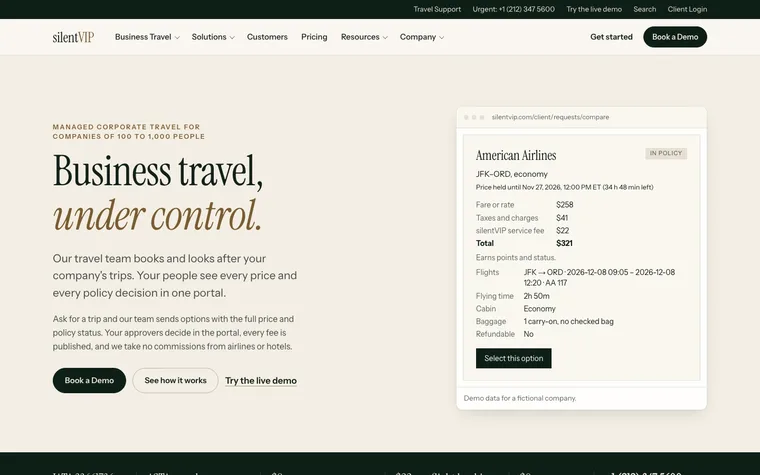
silentVIP is built for them and only for them. It describes itself, precisely, as “managed corporate travel for companies of 100 to 1,000 people.” Its proposition is just as precise: “Our travel team books and looks after your company’s trips. Your people see every price and every policy decision in one portal.”
We admire the discipline of that focus enormously. It is tempting for any young company to claim it serves everyone. silentVIP has done the harder, braver thing: it has picked a customer that it believes is underserved, built everything around that customer, and said openly, including on its own comparison pages, when another kind of provider is likely the better fit. A company that knows exactly who it is for is a company that can become indispensable to them.
Who pays the advisor decides whose side the advisor is on
If one idea above all made us want to lead this round, it is this one.
In much of the travel industry, the party giving advice is paid, at least in part, by the party being recommended. Commissions and supplier incentives are long-standing and not inherently wrong. But they create a quiet conflict that no amount of good intention can fully remove. When an advisor earns more from one hotel than another, the client can never be entirely certain which consideration shaped the recommendation.
silentVIP removes that question entirely. Clients pay published fees, and the company takes no commissions from airlines or hotels. Every option shows the fare, bags, taxes and silentVIP’s service fee as one total, with the change and cancellation rules on the same line. The company’s own phrase for this is “nothing hidden in the fare.” Where a preferred-partner hotel program adds benefits such as breakfast or an upgrade, the company says those benefits go to the traveler, and any program fee paid to silentVIP is disclosed on the client’s invoice. Its plans and per-booking fees sit on a public pricing page, with worked examples, for anyone to read.
We cannot overstate how much we love this. It is not a pricing tactic. It is a statement of allegiance. silentVIP has chosen to answer to exactly one party: the client. Everything else flows from that choice.
It aligns the business with the buyer who matters. In a mid-sized company, the person who signs the travel contract is often the chief financial officer or someone who reports to them. A model in which every fee is visible and the advice carries no supplier incentive speaks directly to that buyer’s instincts.
It makes the service auditable. When the price of a trip and the fee for arranging it are always shown separately, a client can check the value of the service month by month. That is uncomfortable for a weak provider and a gift to a strong one. silentVIP has deliberately chosen to be judged in the open. We think that tells you everything about how confident the team is in the quality of its work.
It compounds trust. A travel company that earns trust earns the right to handle more: the board offsite, the executive’s complex multi-country itinerary, the family trip of the person who owns the company. silentVIP offers exactly that extension, which we come to below, and we do not believe it would be credible without the client-paid model underneath it.
silentVIP has chosen to answer to exactly one party: the client. Everything else flows from that choice.
Why now: the cost of excellent coordination is collapsing
Managed travel is not a new idea. The question every serious investor should ask is what has changed to make it a better business than it was. Our answer, in 2021 and with far more conviction today, is this: the cost of excellent coordination is falling dramatically, while the value of it is not.
Look closely at what a skilled travel advisor actually does all day. Much of it is groundwork: gathering options across airlines and hotels, checking each against a company’s policy, remembering a traveler’s preferences and loyalty accounts, drafting an itinerary, chasing money owed back, tracking an unused credit until it is spent. That groundwork is exactly the kind of work that excellent software, and now generative AI, can take on in meaningful part.
What remains, when the groundwork is lifted, is judgment. Choosing between two options that look identical on paper but are not. Handling a cascading disruption. Knowing what a particular executive will and will not accept. These are the moments when a traveler is most grateful for a human being, and they are the moments a great advisor lives for.
Our view is that AI changes the economics of expert service without changing who is accountable for it. A small, excellent team, supported by purpose-built software, can give many more companies the attention once reserved for a dedicated travel desk.
This is the heart of our thesis, and we think it is one of the great opportunities of this decade: expert human service, once a luxury reserved for the largest enterprises and the wealthiest families, can become available to every growing company in America. Not by replacing the expert, but by giving the expert superpowers.
silentVIP’s stance on AI is one we share completely, and one we think the whole industry should study. It is careful, publicly, about what exists today and what does not. Its website lists AI assistance for clients as “not available today,” and commits that if it is added, “a person will always authorize bookings, changes and payments.” That is not timidity. It is wisdom. In a business where the product is trust, the worst thing a company can do is let a machine make a promise a person has to break. silentVIP is applying technology first where it belongs: behind its own team, making its advisors faster, while expert judgment stays the deciding factor.
There is a second shift, too. Clients now expect software-grade transparency from every service business they use. Finance teams expect to see spend by entity and project without asking. Approvers expect to decide from a phone. Travelers expect their trip in an app that knows their flight is delayed before they do. A managed agency that cannot offer this will, we believe, find itself at a growing disadvantage. One that can offer it, while keeping a named person on the hook for every problem, has a combination that is genuinely rare.
Expert human service, once a luxury for the few, can become available to every growing company in America.
What the team has built
We judge a company less by its slides than by what it has shipped, and by how it treats the details nobody asked about. On that measure, we think silentVIP is extraordinary. The breadth and care of what this team has built genuinely impresses us, and we have seen a great many products.
A complete program, not a brochure. The client portal covers the entire life of a trip. Travelers and assistants request and compare options with the whole price and policy status on every line. A policy engine handles cabin rules by flight length, hotel caps by city, advance-booking rules, preferred suppliers and restricted destinations, so an out-of-policy choice needs a reason and an approver before anything is booked. Approvals and approval chains, delegation, billing by legal entity with allocation to departments and projects, tracking of refunds and unused ticket credits until money comes back, a monthly report that says what to do next, emissions estimates on every booking, and traveler safety tools for locating, contacting and accounting for travelers during an incident. All of it lives in one place.
Finance that closes the month instead of chasing it. Each booking is assigned to a legal entity, department and project code when it is made. Invoices come per entity. Every refund is tracked with an expected date, and chased if it is late. Accounting, expense and HR systems receive files they can import, including journal files for widely used accounting packages, expense files and an HR roster import. And if a file cannot be produced because data is missing, the client sees exactly which rows need fixing. We find that last detail quietly brilliant. It is the difference between software that reports a problem and software that solves it with you.
Enterprise controls, built in. Role scoping, two-factor authentication, data export and an activity log are part of the portal. The company has also built in user provisioning and single sign-on support, ready to be switched on as clients need them. For a company of this age, the seriousness of that foundation speaks volumes.
Native apps, shipped. The silentVIP: Business Travel app is live on the App Store and Google Play, so travelers and approvers can see their travel day, trips, requests and approvals from a phone or watch, with live flight status. The travel team has its own app, silentVIP Advisor, now on Google Play, which brings the request queue, quoting, itinerary building, ticketing, supplier liaison, travel-day operations and safety into a single workspace, with a “Needs you now” view that ranks what each advisor should do next and why.
Internal tools that make advisors faster. The team has built a hotel rate checker that compares public rates with a client’s negotiated corporate codes, so an advisor can answer “what will it cost to house the team in this city that week, and does our code beat the public rate?” without checking dozens of pages by hand. This is exactly the kind of leverage our thesis depends on, and we are thrilled to see it built by the team itself, for its own people.
Generosity as a go-to-market. silentVIP publishes an unusually rich library of resources with no forms and no email gates: guides to corporate travel management, choosing a travel management company, how travel agencies get paid, duty of care, travel risk, sustainable travel and hotel RFPs, plus free tools including a plan finder, policy builder, approval-route designer, budget planner, trip cost estimator, emissions estimator and credit tracker. There is a live demo, built on a clearly labeled fictional company, that anyone can explore, and a sample monthly report. We believe a company that teaches its market this generously earns the market’s trust long before it earns its business.
Commitments with consequences. silentVIP says urgent issues are acknowledged within five minutes and owned by a named agent within fifteen, with urgent help available around the clock. It commits to returning trip options within four business hours. Hotels are reconfirmed with the property before check-in. A named person owns every issue until it is resolved, and the client can see who it is. Handovers between shifts are written up, so nothing is lost. And for early clients, the company waives a booking’s service fee if it misses the four-hour commitment. We love companies that put a number in public and accept a consequence for missing it. It is the clearest signal of confidence a service business can send.
Honesty as a competitive weapon
There is a section on silentVIP’s website titled “Honest limits.” We think it may be the most powerful piece of marketing in the category.
It says that live self-service search across airline and hotel inventory is not available today. It says the company offers no corporate cards or expense management. It says that integrations are files rather than live connections. On its company page, it says it has no SOC 2 or ISO 27001 report yet, and invites procurement teams to ask for its security questionnaire answers instead. It does not publish customer logos or stories until clients approve them. Its homepage says, with a candor we have rarely seen: “No logos yet. Here’s the evidence instead,” and invites companies to become early clients on a 90-day pilot, judged on the live demo, the published response times and the sample monthly report.
Most companies hide their gaps. silentVIP lists them. And in doing so, it achieves something remarkable: a company that is precise about what it cannot do yet is a company whose claims about what it can do are worth believing.
No logos yet. Here’s the evidence instead.
In a category where trust is the product, that habit is not a weakness to be managed. It is an asset to be compounded. Every buyer who reads “Honest limits” and then finds the product does exactly what the site says has a reason to believe everything else the company tells them. Over years, we expect that reputation for candor to become one of silentVIP’s most valuable and least copyable assets.
The company’s company page goes further still, setting out who is accountable for what: the chief executive for client agreements and commercial terms, a head of travel operations for booking, ticketing and disruption, a head of client service for account management and escalations, and an implementation lead who owns every onboarding from kickoff to launch. We think that plainness says something deep about the culture the team is building.
Why incumbents cannot simply follow
Whenever we back a company that challenges an established category, we ask a hard question: why can’t the existing players just copy this? In silentVIP’s case, we believe the answer is unusually strong, because its advantages are built into its foundations rather than bolted onto its features.
Business models are harder to change than products. A provider whose economics depend in part on supplier commissions or supplier-subsidized pricing cannot simply announce that it takes nothing from airlines or hotels. Doing so would mean rebuilding its revenue from the ground up and asking every client to start paying explicitly for something they may believe is free today. silentVIP never had to make that transition. Its model was clean from the start.
Architectures encode assumptions. A system designed around a self-booking tool treats the phone call as an exception, because that is what it was built to do. A system designed around agents treats the portal as an add-on. silentVIP built one program in which every route is a peer. In our view, retrofitting that unity into a system built on the opposite assumption is far harder than it looks from the outside.
Focus is a choice incumbents cannot easily make. A provider that serves both the largest enterprises and the smallest startups must split its attention, its roadmap and its service model. silentVIP has committed itself to companies of roughly 100 to 1,000 people. Every feature, every service standard and every price is tuned for them. That kind of focus is a structural advantage, not a temporary one.
Candor is a culture, and cultures are slow to change. It is easy to publish a pricing page. It is much harder to build an organization that is comfortable listing its own limits, waiving its own fees when it misses a promise and showing clients who is accountable for what. We believe that culture is one of silentVIP’s deepest moats, precisely because it cannot be purchased or announced. It has to be lived.
None of this means the competition is weak. The established players are capable, well-resourced and serve many companies well. We simply believe silentVIP has chosen a position that the existing shape of the market makes hard to occupy, and has occupied it with conviction.
How the advantage compounds
Great businesses are not just good on day one. They get better with every day that passes. We believe silentVIP is built to compound in at least four ways.
Every request makes the next one better. Each trip adds to what silentVIP knows about a client: traveler preferences, loyalty accounts, documents, approval chains and the company’s policy as it is actually applied. The company’s own platform keeps that knowledge on file, “so every request begins where the last one ended.” The longer a client stays, the better the service gets, the less anyone has to repeat themselves and the more costly it becomes to leave. That is a flywheel we would be delighted to own.
Every tool makes every advisor more capable. Each internal tool silentVIP builds, from the hotel rate checker to the Advisor app’s ranked “Needs you now” view, raises the ceiling on what one expert can handle well. We expect this to show up as more clients and trips per advisor with service quality steady or rising. If that happens, the company gains a structural cost advantage that grows with every improvement it ships.
Every honest promise kept builds reputation. In a market where trust is scarce, each kept commitment adds to a reservoir of credibility. Reputations in service businesses tend to travel by word of mouth between finance leaders, assistants and executives. We believe silentVIP is building the kind of reputation that does its selling for it.
Every corporate relationship opens the door to a personal one. silentVIP offers private travel as an optional extension of a corporate program: owner and family travel, private events and complex journeys, kept entirely separate from the company account. Private trips have their own sign-in, their own payment and their own visibility. The employer never sees private trips, costs or destinations, and they never appear in company reports, exports or safety lists. Shared profile details are reused only with the traveler’s consent.
We think this extension is one of the company’s most valuable and least appreciated assets. For the owners and executives of mid-sized companies, the people who run the company’s travel are often the people they would most like to trust with their own family holiday, their multi-generational trip or the event they host at home. silentVIP earns that trust on the company’s trips first, and then extends it to the trips that matter most in a person’s life. It is only possible because the corporate program comes first, and because the client-paid model makes the advice trustworthy.
The same core system is also proving its reach beyond corporate clients. silentVIP for Good applies a managed program to nonprofits, volunteer organizations and schools, with tools for budgets, grants and duty of care. We do not underwrite this as a separate business. But it shows us something important: a policy-led program run by an accountable team is not specific to one kind of client. It is a general answer to a general problem.
silentVIP earns trust on the company’s trips first, and then extends it to the trips that matter most in a person’s life.
The world we believe silentVIP can build
Let us be ambitious for a moment, because we think the ambition is warranted.
Imagine a world in which every growing company in America has what only the largest enterprises have today: a real travel program, run by experts, with complete visibility and no conflicts of interest.
In that world, the executive assistant gets their evenings back. The person who today spends hours juggling flights, approvals and changes for the people they support hands that work to a team they trust, inside a portal where every decision is recorded. They become the orchestrator, not the switchboard.
In that world, the finance team closes the month without a chase. Every trip is allocated when it is booked. Every refund is tracked until it lands. Every unused credit is visible and spent. The monthly report arrives with actions, not just numbers. Travel becomes one of the cleanest lines in the ledger instead of one of the messiest.
In that world, the traveler never feels alone. When a flight is canceled at 11 p.m., a named person takes ownership and stays with it until the traveler is rebooked. Nobody re-explains the trip. Nobody waits on hold wondering if anyone cares. The traveler feels what it means to have a team behind them.
In that world, advice is clean. Every recommendation is made by an advisor who earns nothing from the supplier. Every fee is visible. Every benefit from a preferred hotel goes to the traveler. Clients stop wondering whose side their travel provider is on, because the answer is printed on every invoice.
In that world, the best human expertise reaches more people than ever before. A small, excellent team, amplified by software and, in time, by carefully governed AI, gives hundreds of companies the kind of attention that was once reserved for a handful. That is not a story about replacing people. It is a story about multiplying what the best people can do.
We believe silentVIP can build that world. Not overnight, and not without hard work, but on foundations that are, in our view, exactly right. And if it does, the effect will reach far beyond travel. It will show that a service business can be transparent, accountable, technology-led and deeply human at the same time. We expect that example to change what companies demand from every service provider they use.
We believe silentVIP can show that a service business can be transparent, accountable, technology-led and deeply human at the same time.
The risks we hold ourselves to
Conviction is not the same as certainty, and a letter that ignored the risks would not be worth reading. These are the risks we discussed most when we invested, and how we think about them today.
Competition from well-resourced players. The self-service platforms are large, capable and adding service. Global agencies are adding software. silentVIP will compete with both. We never needed silentVIP to win every company of 300 people; we believe it needs to win the ones for whom its model is plainly better, and keep them. We think that is a very large and very attractive group.
The economics of service. People are expensive, and growth in a service business can quietly erode margins. We will watch the ratio of clients and trips to advisors more closely than almost any other measure. Our whole thesis says the investment in tooling should show up there. If it does not, we will say so.
Trust and security. Travel companies hold sensitive personal information: passport details, itineraries and the movements of executives and their families. silentVIP has built strong controls into its portal and publishes a trust center. It does not yet have an independent security assessment, and many procurement teams will ask for one. We regard earning that assurance as a priority.
Proof. silentVIP invites companies to become early clients and, rightly, publishes no customer stories without approval. The next phase has to produce referenceable clients who renew. We believe the team will do it, and do it without shortcuts.
Focus. The founders have a broad ambition and have built across web, portal and native apps for both clients and advisors. Breadth is a strength when it serves one program and a risk when it scatters attention. We will keep encouraging the company to sequence its work around the corporate client first, with private travel and adjacent programs built on that base.
What the round was for, and how we judge it
The round gave silentVIP the capital to build a program on these principles and to turn it into a proven one. We do not publish amounts by line, and the plan has evolved with what the company has learned. Its priorities today, as we understand them, are clear.
The travel team. The heart of the service is people who own the problem. The company needs to hire and train advisors ahead of demand, so its published commitments hold as clients join.
The self-service layer, where it belongs. Live search across flight and hotel inventory is the capability clients most often ask for that silentVIP does not offer today. The company has begun work on live flight search. The aim is not to become a self-booking tool, but to let travelers who want to book directly do so inside the same policy, approvals and billing, with the team behind every trip. When that arrives, we believe silentVIP will offer something genuinely new: self-service with a safety net, inside a single program.
Direct integrations and independent assurance. Live connections to the systems finance and HR teams already use, and a recognized security assessment so that procurement teams can verify what silentVIP already documents.
Tools that make advisors faster. Continued investment in the Advisor app and internal tools, with technology applied to the groundwork of quoting, itinerary building and follow-up, and expert judgment kept where the stakes are.
Evidence, earned with consent. A deliberate program to turn early clients into references and case studies, with their written approval, as the company already promises.
Where silentVIP asks for it, Caldrion Ventures also makes the studio’s product, engineering and AI capabilities available. The company leads its own plan; our role is to be useful, patient and candid.
Our capital is permanent, and we answer to no timetable for returning it. That lets us judge silentVIP on whether the business is getting better, not on whether it can be sold quickly. We will consider this investment a success if clients stay and expand; if the published commitments hold as the client base grows; if each advisor serves more travelers, better; if the model stays clean, with no supplier commissions and every fee itemized; if procurement teams say yes; and if the economics work, with revenue that comes from clients paying for a service they value, at a cost that improves with scale. We make no promises about financial outcomes. What we can promise is that we will be clear about what we expected and honest about what happened.
A closing word
We do not lead rounds lightly. We do it only when we are prepared to stand behind a company for a very long time, and when we led silentVIP’s Series A in 2021, that is exactly what we committed to.
Five years on, we are more excited about this company than we have ever been. silentVIP has every quality we look for in a founder-led business, and several we rarely find together: a clear view of a neglected customer, a business model that keeps it permanently on that customer’s side, a product of real breadth and craft that has actually shipped, a culture of public commitments and a rare habit of telling the truth about its own limits.
We believe managed corporate travel, rebuilt around one program, published fees, expert people and software that multiplies what those people can do, is not just a better business than the market gives it credit for. We believe it is the future of how growing companies will move their people. And we believe silentVIP is the company most likely to build it.
We were proud to back this team in 2021. We are prouder still to be backing it today.
More on the themes behind this investment: applied AI for specific workflows and travel planning and discovery.
— Caldrion Ventures
This letter reflects Caldrion Ventures’ views as of November 2026. It is not an offer of securities or investment advice.